



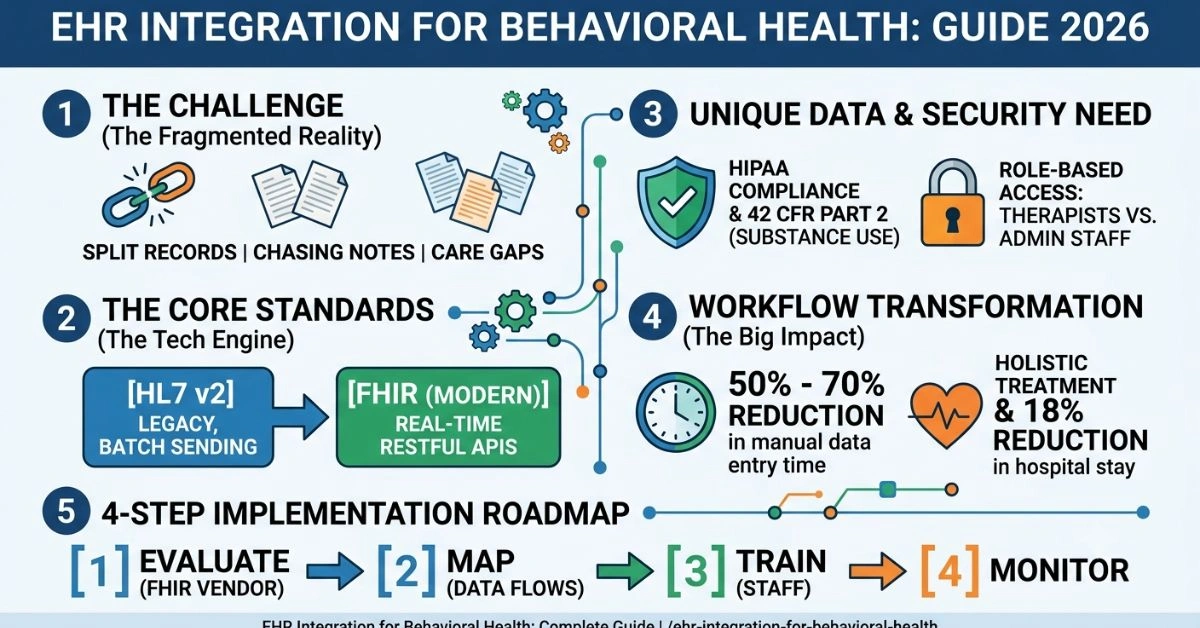
Behavioral health practices deal with fragmented records daily. Clinicians chase notes across systems, miss critical history from primary care providers, and spend hours on manual data entry instead of patient sessions. EHR integration for behavioral health directly addresses these pain points by connecting disparate systems into one reliable flow of information.
Facilities that achieve strong integration report fewer duplicated efforts, faster access to complete patient histories, and better coordination between therapists, psychiatrists, and medical teams. This matters because behavioral health patients often manage co-occurring conditions that require input from multiple specialists. Without integrated records, important details slip through cracks, delaying interventions and affecting recovery.
This guide walks through the real mechanics of making integration work. It covers technical hurdles, compliance demands, standards like HL7 and FHIR, workflow changes, and measurable impacts on patient care. Administrators and clinicians will find actionable steps grounded in current practices.
Understanding the Unique Needs of Behavioral Health Data
Behavioral health records differ from standard medical ones. They include detailed therapy notes, risk assessments, substance use histories, and psychosocial factors that don’t fit neatly into traditional EHR templates. Many legacy systems prioritize physical health metrics like lab results and vital signs, leaving behavioral data in unstructured free text or separate silos.
This mismatch creates real problems. A psychiatrist prescribing medication needs immediate visibility into recent therapy progress and any suicidal ideation flags. A primary care doctor referring a patient for anxiety treatment benefits from seeing prior medication trials and outcomes. Without integration, teams rely on phone calls, faxes, or patient self-reports—methods prone to gaps and errors.
Effective integration must handle sensitive information with care. Behavioral health data often carries extra legal protections, such as those under 42 CFR Part 2 for substance use disorders, which add consent and redisclosure rules on top of standard HIPAA requirements.
Practices integrating successfully start by mapping their specific data flows. They identify key touchpoints: intake assessments, session documentation, treatment plan updates, referral exchanges, and outcome tracking. This mapping reveals where current systems fall short and where integration delivers the biggest gains.
Technical Challenges in EHR Integration for Behavioral Health
Integration projects hit common roadblocks. Legacy EHRs in many behavioral health settings use outdated architectures that resist modern APIs. Data formats vary wildly—some systems export in HL7 v2 messages, others in proprietary structures—making clean transfers difficult.
Staff resistance adds another layer. Clinicians accustomed to paper notes or basic digital templates worry that new interfaces will slow them down or force rigid documentation that doesn’t capture nuanced therapeutic conversations. Training gaps compound this, especially in smaller practices with limited IT support.
Data quality issues surface quickly. Inconsistent coding of diagnoses, varying use of standardized assessment tools like PHQ-9 or GAD-7, and incomplete fields create “dirty” data that propagates errors across connected systems. Migrating historical records without proper cleansing often leads to incomplete patient profiles in the new integrated environment.
Scalability presents ongoing headaches. As practices grow or merge with larger networks, the integration must handle increasing volumes without performance lags. Real-time syncing becomes essential for telehealth sessions or crisis interventions where delays could impact safety.
Many organizations underestimate the resource commitment. Successful projects allocate dedicated teams for testing, iterative adjustments, and ongoing monitoring rather than treating integration as a one-time IT install.
Workflow Optimization Through Integration
Well-designed integration transforms daily operations. Automated eligibility checks reduce administrative time at intake. Bidirectional data flows let therapy notes populate shared care plans visible to the full treatment team. Alerts notify providers of critical updates, such as medication changes or missed appointments.
Consider a typical integrated workflow. A patient completes a digital intake form that feeds directly into the EHR. The system flags relevant history from connected primary care records and suggests appropriate screening tools. During a session, the therapist documents progress in structured fields that automatically update the treatment plan and trigger billing codes. Psychiatrists see real-time updates on adherence and side effects without separate logins.
This connectivity cuts documentation burden significantly. Practices report 50-70% reductions in time spent on manual data entry after full integration. Time saved translates to more patient-facing hours and reduced burnout among providers.
Group therapy and residential programs benefit particularly. Integrated systems track attendance across multiple sessions, generate unified progress reports, and support outcome measurement over extended care episodes. Care coordinators gain dashboards showing population-level trends, helping allocate resources where they matter most.
Telehealth integration adds another dimension. Seamless video platforms linked to the EHR allow automatic charting, e-sign consent forms, and immediate post-session documentation without switching applications.
HIPAA Compliance and Data Security in Integrated Systems
HIPAA compliance forms the non-negotiable foundation. Integrated environments increase data movement, which expands potential breach surfaces. Organizations must implement robust access controls, audit logging, encryption for data in transit and at rest, and business associate agreements with all integration partners.
Behavioral health adds complexity due to heightened stigma and sensitivity. Providers implement role-based access so therapists see detailed notes while administrative staff view only scheduling and billing information. Consent management tools track patient permissions dynamically, especially important for 42 CFR Part 2 data.
Regular security audits and penetration testing help identify vulnerabilities before exploitation. Staff training emphasizes phishing awareness and proper handling of portable devices. Backup and recovery protocols ensure continuity even if primary systems face ransomware or technical failures. For instance, reliable data recovery solutions become essential safeguards when integrating complex systems.
Incident response plans must cover integrated scenarios where a breach in one connected system could affect multiple partners. Clear policies on data minimization—sharing only what’s necessary—reduce risk while maintaining care quality.
Data Interoperability Standards: HL7 and FHIR
HL7 and FHIR standards drive modern interoperability. Traditional HL7 v2 messaging handles many legacy interfaces, particularly for admissions, discharges, and basic clinical data. However, FHIR has emerged as the preferred approach for behavioral health due to its flexibility and web-based architecture.
FHIR breaks data into modular resources—Patient, Condition, Observation, CarePlan, etc.—that systems can exchange via RESTful APIs. This allows precise, on-demand data pulls rather than bulky batch transfers. Behavioral health-specific profiles address unique needs like standardized documentation of therapy interventions or social determinants of health.
Implementation often combines both standards. Legacy systems continue using HL7 v2 while new connections leverage FHIR. SMART on FHIR adds authorization layers for secure app integrations, enabling third-party tools for outcome tracking or patient engagement without compromising security.
USCDI+ Behavioral Health initiatives push for expanded data elements in federal interoperability requirements. Practices adopting these standards position themselves better for value-based care contracts and health information exchange participation.
Comparison of Interoperability Approaches
| Aspect | Standalone EHR | Integrated EHR with FHIR/HL7 |
| Data Exchange | Manual or limited | Real-time, automated |
| Workflow Efficiency | Fragmented | Unified across teams |
| Compliance Management | Basic | Advanced consent & auditing |
| Scalability | Limited | Supports growth & telehealth |
| Patient Outcomes | Slower coordination | Improved continuity of care |
This table highlights why many organizations move toward integrated models.
Measuring Impact on Patient Outcomes
Integrated EHR systems correlate with tangible clinical improvements. Complete records enable more accurate risk assessments and personalized treatment plans. Care teams identify medication interactions or contraindications faster. Coordinated follow-up reduces hospital readmissions for patients with severe mental illness.
Studies show enhanced integration supports better management of co-occurring disorders. Primary care providers receive timely behavioral health updates, leading to more holistic treatment. Patients experience fewer redundant assessments and smoother transitions between care levels.
Outcome measurement becomes systematic. Integrated platforms automatically track standardized tools over time, generating reports for individual progress and population health management. This data supports quality improvement initiatives and demonstrates value to payers.
Case examples illustrate the point. One multi-site behavioral health organization achieved an 18% reduction in average length of stay after Epic integration through better care planning. Another saw significant improvements in treatment plan coordination and documentation efficiency.
Longer-term benefits include stronger patient engagement. Portals connected to integrated records let individuals access their information, message providers, and participate more actively in care.
Implementation Roadmap and Best Practices
Successful EHR integration follows a phased approach. Start with needs assessment and vendor evaluation focused on behavioral health-specific capabilities. Prioritize platforms with proven FHIR support and existing connections to common partners like labs and pharmacies.
Build a cross-functional team including clinicians, IT staff, administrators, and compliance officers. Develop detailed project timelines with clear milestones for testing and go-live. Pilot integrations in one department before organization-wide rollout.
Data migration requires meticulous planning. Clean and map historical records carefully. Parallel running of old and new systems during transition minimizes disruption. Comprehensive staff training tailored to different roles ensures adoption.
Post-implementation, monitor key performance indicators such as documentation completion rates, error frequencies in data exchange, user satisfaction scores, and clinical outcome metrics. Plan for ongoing optimization as regulations and technology evolve.
Budget for total cost of ownership, including maintenance, updates, and potential custom development. Build-vs-buy decisions depend on organizational size and technical expertise. Many find hybrid approaches most practical.
For practices scaling operations, robust data architecture supports sustainable growth, much like efficient rental management platforms handle expanding inventories and user bases effectively.
Overcoming Common Pitfalls
Alert fatigue frustrates users when integrated systems generate too many notifications. Configure rules thoughtfully and allow customization. Poor user interface design leads to workarounds that undermine integration benefits. Involve end-users heavily in design and testing phases.
Vendor lock-in concerns many administrators. Choose solutions with open APIs and strong export capabilities. Contract terms should address data ownership and transition support.
Budget overruns occur without realistic scoping. Build contingency into timelines and resources. Underestimating change management often derails technical success. Address cultural shifts alongside technology implementation.
Future Directions
Artificial intelligence will likely enhance integrated behavioral health records through predictive analytics for risk stratification, automated documentation assistance, and personalized treatment recommendations. Continued FHIR evolution will support richer data exchange, including social care information and patient-generated data from wearables or apps.
Regulatory pushes toward greater interoperability, such as TEFCA, will accelerate adoption. Value-based payment models reward organizations that demonstrate coordinated, outcome-focused care—capabilities strengthened by strong integration.
FAQs
1. What makes EHR integration different for behavioral health compared to physical medicine?
Behavioral health requires more narrative documentation, specialized assessment tools, and stricter privacy controls for sensitive topics. Integration must accommodate these while connecting to medical records for whole-person care.
2. How long does typical EHR integration take for a behavioral health practice?
Timelines range from 3-12 months depending on practice size, existing systems, and data complexity. Smaller practices with modern platforms often complete core integration in 4-6 months with proper planning.
3. Does FHIR replace HL7 completely in behavioral health settings?
No. FHIR handles most new development and real-time needs, while HL7 v2 supports legacy interfaces. Many organizations run both during transition periods.
4. What are the biggest HIPAA risks during integration projects?
Expanded data flows increase breach potential. Key risks include inadequate business associate agreements, weak access controls, and incomplete audit logging. Thorough vendor vetting and ongoing monitoring mitigate these.
5. How can small behavioral health practices afford integration?
Cloud-based solutions with subscription pricing lower upfront costs. Federal incentives, grants for behavioral health IT, and phased implementations help manage expenses. Focus on high-ROI connections first, such as billing and referral management.
6. Will integration improve reimbursement rates?
Yes, through better documentation supporting medical necessity, reduced claim denials, and eligibility for value-based contracts. Accurate, complete records also streamline prior authorizations.
7. What role does staff training play in successful integration?
Training determines adoption rates. Effective programs combine technical skills with workflow changes and address concerns about documentation burden. Ongoing support after go-live proves essential.
For More Information Visit Aitrender.