



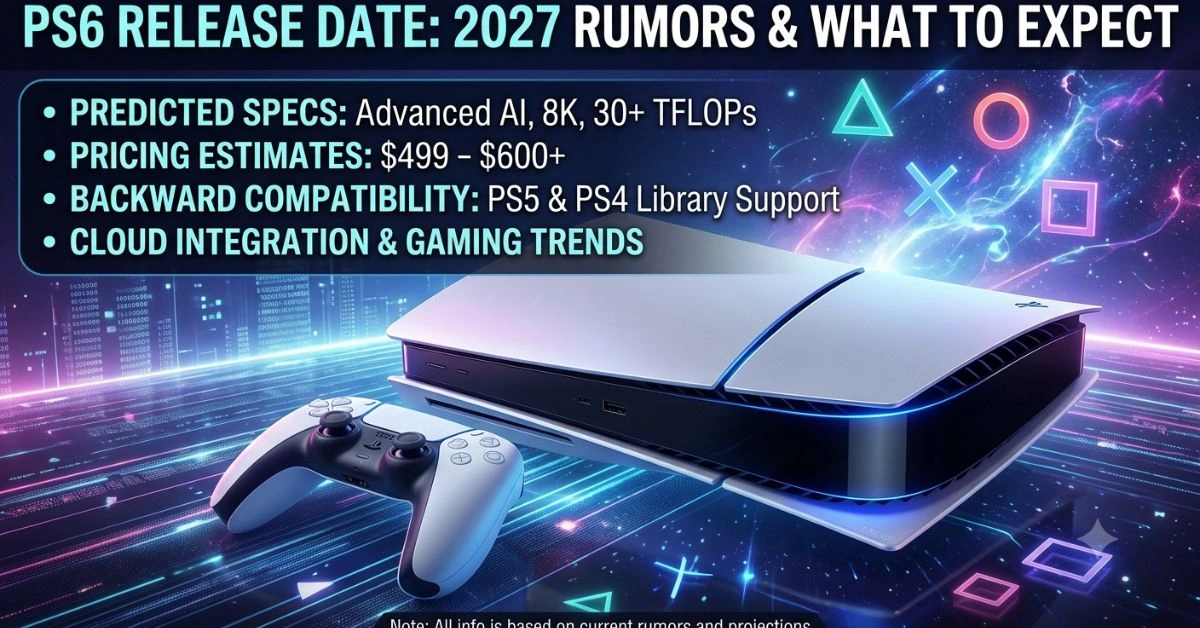
PlayStation fans have ridden the wave from the PS5’s chaotic launch in 2020 through the PS5 Pro refresh in late 2024. Now eyes turn to the horizon. The question on everyone’s mind echoes across forums, comment sections, and search bars: when is PS6 release date?
Sony hasn’t dropped an official word yet, but the pattern, leaks, and industry pressures paint a picture of a late 2027 launch window that’s holding steady despite some turbulence. This isn’t just another console cycle. It’s the next chapter in a platform that’s defined home gaming for decades.
The Historical Console Cycle: Why 2027 Makes Sense
Sony’s PlayStation generations have followed a fairly consistent rhythm. The PS4 landed in 2013, the PS5 in November 2020—roughly seven years apart. That timeline has held through most major entries, giving developers breathing room to master new hardware while keeping the business humming.
The PS5 Pro arrived as a mid-generation powerhouse in November 2024, boosting GPU performance by about 45%, doubling storage to 2TB in many configs, and introducing PlayStation Spectral Super Resolution (PSSR) for sharper upscaling. It came in at $699, a premium that signaled Sony’s willingness to charge for cutting-edge features.
If history repeats, the full next-generation leap should arrive around seven years after the PS5’s debut. That points squarely to holiday 2027. Multiple insiders, including KeplerL2, have reinforced this timeline, stating the project remains on track despite supply chain chatter. Holiday releases maximize sales momentum, aligning with family gift-giving and big game drops.
Some analysts floated delays to 2028 or 2029 because of skyrocketing RAM prices driven by AI data center demand. Console makers face tough choices on component costs versus selling at a loss early on. Yet recent updates push back against major slips, suggesting Sony sees value in sticking closer to the original plan.
Inside the Rumors: What We Know (and Don’t) About PS6 Hardware
Leakers and supply chain whispers offer glimpses, but nothing concrete from Sony. Expect a significant jump in raw power, especially in GPU and memory, to handle 8K ambitions, advanced ray tracing, and massive open worlds running at stable high frame rates.
Predictions include AMD’s next-gen architecture, potentially pushing beyond the PS5 Pro’s 16.7 TFLOPs toward something far more capable. Storage could expand further with faster SSDs, making load times nearly invisible. CPU improvements would benefit simulation-heavy games—think denser NPC crowds, smarter AI behaviors, and physics that feel alive.
Power efficiency matters too. Sony has emphasized sustainability and quieter designs. The PS6 might run cooler under load, important for living rooms where noise grates on the nerves.
Pricing speculation lands in the $500-$600 range for a base model, though inflation and component costs could nudge it higher. A Pro variant might follow a couple years later at premium territory. Sony learned from past launches: balance accessibility with enough muscle to wow developers.
Predicted PS6 Specifications Comparison Table
| Feature | PS4 (2013) | PS5 (2020) | PS5 Pro (2024) | PS6 (Expected 2027) |
| GPU Power (TFLOPs) | ~1.84 | $10 | ~16.7 | 30+ (projected) |
| Storage (Base) | 500GB HDD | 825GB SSD | 2TB SSD | 2-4TB SSD |
| RAM | 8GB GDDR5 | 16GB GDDR6 | 16GB + extra | 32GB+ GDDR7? |
| Max Resolution/Frame | 1080p/60 | 4K/120 | Enhanced 4K/60+ | 8K/60 or 4K/120+ |
| Launch Price (USD) | $399/$499 | $399/$499 | $699 | $499-$599? |
| Key Tech | Basic shaders | Ray tracing, SSD | PSSR AI upscaling | Advanced AI, cloud integration |
This table highlights the generational leaps. The PS6 needs to deliver meaningful upgrades that justify the upgrade for millions of PS5 owners.
Backward Compatibility: Protecting Your Library
One of the biggest concerns for any new console is what happens to your existing games. Sony improved dramatically here with the PS5, offering near-perfect PS4 compatibility. The PS6 is expected to build on that foundation, likely supporting PS5 and PS4 titles out of the box, possibly extending further.
Rumors suggest enhanced emulation layers or hardware features that could bring select PS3 games into the mix more reliably than current cloud options. Full backward compatibility strengthens the value proposition—your massive digital and physical library doesn’t become obsolete overnight.
This matters for long-term ownership. Gamers invest thousands over years. Sony’s preservation efforts hint at a stronger commitment here, especially as they tease ambitions for classic titles ahead of the next generation.
For the latest on upcoming titles and how they might transition across generations, check out the expansive coverage at aitrender.net/games/. It breaks down libraries and compatibility trends that will define the PS6 era.
The Role of AI in Shaping Next-Gen Development
Modern game development has grown brutally complex and expensive. That’s where tools like AI come into play—not as a replacement for human creativity, but as infrastructure that speeds up asset creation, testing, and optimization.
Sony has ramped up hiring for AI-related roles in PlayStation studios. This aligns with broader industry shifts where procedural generation, smart upscaling, and automated QA could help deliver bigger, more polished experiences on next-gen hardware.
Platforms like full-stack app builders are already transforming how teams prototype and iterate. For a deeper look at how AI infrastructure powers modern development pipelines that will influence console gaming, see this BLDR AI full-stack app builder review and guide. It highlights the backend tech making ambitious projects feasible.
Expect the PS6 to leverage AI heavily on the player side too—better NPC dialogue, adaptive difficulty, real-time graphics enhancements, and perhaps personal assistants that understand voice commands in-game.
Cloud Gaming and Hybrid Experiences
Sony isn’t abandoning physical consoles for pure streaming. Executives have stated clearly that most players prefer local hardware for reliability and control. Still, cloud tech will expand options.
The PS6 could feature tighter integration with PlayStation’s streaming services, allowing seamless handoff between local play and cloud for longer sessions or remote access. A rumored handheld variant might pair with it, creating a true ecosystem play.
This hybrid approach—powerful local console plus robust cloud—could define the generation. It gives flexibility without forcing everyone onto unstable internet connections.
First-Party Powerhouse: What Games Could Drive the Launch
Sony’s strength has always been its studios. Expect heavy hitters to anchor the PS6 launch. New entries in God of War, Horizon, Spider-Man, and Gran Turismo franchises will showcase the hardware. Naughty Dog, Santa Monica, Guerrilla, and Insomniac continue pushing boundaries.
Third-party support remains crucial. Multiplatform titles will look and run best on PlayStation, especially with custom features. The transition period will see plenty of cross-gen releases, giving developers time to fully utilize PS6 capabilities.
The ecosystem extends beyond single-player blockbusters. Live service games, indie darlings, and VR advancements (building on PSVR2) will fill the library. Backward-compatible gems get new life with faster loads and better visuals via patches.
Pricing Strategy and Market Realities
Console launches involve careful math. Sell hardware at a loss initially, recoup through services, accessories, and software. The PS5 Pro’s $699 price tested premium waters. The PS6 base model needs to feel accessible while funding ambitious tech.
Factors like global economics, chip availability, and competition from Microsoft and Nintendo will influence final numbers. Analysts watch Sony’s financials closely—strong PS5 sales and subscription growth provide a runway.
Accessories will evolve: new DualSense features with advanced haptics, adaptive triggers tuned for next-gen feedback, and perhaps modular designs.
Potential Challenges and Opportunities
Supply chain issues, particularly around high-bandwidth memory, remain a wildcard. AI demand isn’t slowing, so Sony must secure components smartly.
Competition heats up. Nintendo’s Switch successor focuses on portability and family fun. Microsoft’s next Xbox emphasizes cloud and Game Pass. Sony doubles down on premium single-player experiences while expanding services.
Opportunities abound in accessibility, social features, and creator tools. Imagine built-in editing suites powered by AI or easier mod support.
The environmental angle matters too—recyclable materials, energy-efficient designs, and programs for trading in old hardware.
Preparing for the PS6 Era
If you’re on the fence about buying a PS5 now, consider your timeline. The current generation still has years of strong support. Big titles are coming, and the PS5 Pro delivers excellent performance today.
For those planning ahead, start building your library. Digital purchases carry forward. Physical collectors should maintain good condition—backward compatibility often favors discs.
Stay informed through official channels, but treat early leaks with healthy skepticism. Sony reveals details on their schedule, usually with a polished showcase.
The Bigger Picture: Why the PS6 Matters
Gaming evolves rapidly, yet the core appeal of a dedicated console—plug in, play great games without fiddling—endures. The PS6 represents Sony betting on that future while adapting to new realities: AI assistance, cloud flexibility, and ever-richer worlds.
It won’t revolutionize everything overnight, but it will raise the bar for immersion, performance, and convenience. From loading screens that vanish to graphics that blur reality and digital, the leap feels significant.
Gamers who lived through the PS2-to-PS3 jump remember the awe. This cycle promises similar excitement, grounded in lessons from past generations.
Technical Deep Dive: What Developers Are Saying
Game creators quietly discuss next-gen requirements in interviews and panels. Bigger worlds demand more memory and faster storage. Ray tracing at scale needs serious silicon. AI-driven animation and audio synthesis could reduce manual labor, letting teams focus on storytelling.
Sony’s custom chips have historically delivered advantages in specific areas like the SSD controller. Expect similar secret sauce in the PS6—perhaps dedicated hardware for decompression or neural processing.
Thermal design will improve. The PS5’s size drew criticism; engineers likely aim for slimmer profiles without sacrificing quiet operation under load.
Variable frequency tech from current gens will refine further, balancing power and performance dynamically based on game demands.
Global Availability and Regional Considerations
Launch timing often starts in major markets—North America, Europe, Japan. Supply constraints hit hard in 2020; Sony will prepare better this time, though demand will spike regardless.
Pricing varies by region due to taxes, currency, and local strategies. Expect bundles with controllers, games, or subscriptions to sweeten the deal.
Emerging markets matter more than ever. Affordable entry points or digital-focused SKUs could broaden the audience.
Community and Cultural Impact
PlayStation isn’t just hardware—it’s a cultural touchstone. From speedruns to esports, fan art to competitive scenes, the PS6 will fuel new waves of creativity.
Online features will evolve. Better party systems, cross-play improvements, and safety tools reflect growing awareness of community health.
Accessibility options have improved dramatically; the next console will expand them—voice-to-text, customizable controls, visual aids—all standard.
Long-Term Roadmap Beyond Launch
Post-launch, expect a Pro model within 3-4 years, just like this generation. Iterative updates keep the platform fresh while the base hardware ages gracefully.
Services like PlayStation Plus will integrate deeper, perhaps with cloud saves, streaming tiers, and exclusive content.
Sony’s investment in first-party studios ensures quality. Acquisitions or partnerships could add surprise exclusives or shared IP.
Addressing Skepticism: Is a New Console Still Relevant?
In an era of powerful PCs and mobile gaming, some question the need. Yet consoles deliver optimized experiences, couch multiplayer, and consistent performance at a fixed price. They lower the barrier for millions who don’t want to build or upgrade PCs.
Cloud gaming complements rather than replaces. Latency issues and data caps keep dedicated hardware king for many scenarios.
Sony’s own statements affirm this: consoles aren’t going anywhere. The platform evolves, but the dedicated box remains central.
Final Thoughts on Timing Your Upgrade
The PS6 release date centers on late 2027, give or take potential minor adjustments. That’s still over a year away as of mid-2026. Use this time to enjoy current games, complete backlogs, and watch for official teases.
Whether you’re a die-hard collector or casual player, the next PlayStation promises to deliver memorable experiences. The industry moves fast, but thoughtful preparation makes the jump smoother.
Stay tuned to reliable sources. Hype builds naturally—don’t let it cloud practical decisions about your setup today.
Frequently Asked Questions
1. When is the PS6 release date expected?
Current rumors and insider reports point to a holiday 2027 launch, likely November, following Sony’s traditional pattern. Some delay speculation exists to 2028 due to component costs, but recent updates suggest the 2027 target holds.
2. Will the PS6 be backward compatible with PS5 and PS4 games?
Strong expectations point to yes, with robust support for PS5 and PS4 titles. Further compatibility with older generations like PS3 remains under discussion but shows promising signs from Sony’s preservation work.
3. How much will the PS6 cost?
Predictions range from $499 to $599 for the base model. Factors like advanced components could push it higher, similar to the PS5 Pro’s positioning. Bundles and variants will offer options.
4.What specs are rumored for the PS6?
Expect major GPU and memory upgrades, faster storage, enhanced ray tracing, and AI features. Details remain speculative until official reveals, but generational leaps in performance are standard.
5. Should I buy a PS5 now or wait for the PS6?
The PS5 and PS5 Pro offer excellent gaming today with years of support ahead. Waiting makes sense only if you can hold off on new releases comfortably. Many titles will be cross-gen.
6. Will the PS6 support 8K gaming?
Likely yes for select experiences, with strong 4K at high frame rates as the focus for most games. Hardware capabilities will exceed current limits significantly.
7. How does AI factor into the PS6?
AI will enhance development tools, graphics upscaling, in-game features, and player assistance. Sony is actively investing in these areas for next-gen advantages.
8. Is there a rumored PS6 handheld?
Yes, alongside the main console, with potential 2027 timing. It could integrate deeply with cloud and local play.
9. Will physical games still work on PS6?
Backward compatibility plans strongly suggest physical discs from supported generations will function, maintaining collector value.
10. What makes the PS6 different from a PC upgrade?
Optimized console experience, exclusive titles, seamless multiplayer, controller innovations, and lower entry barrier for high-fidelity gaming without ongoing upgrades.