



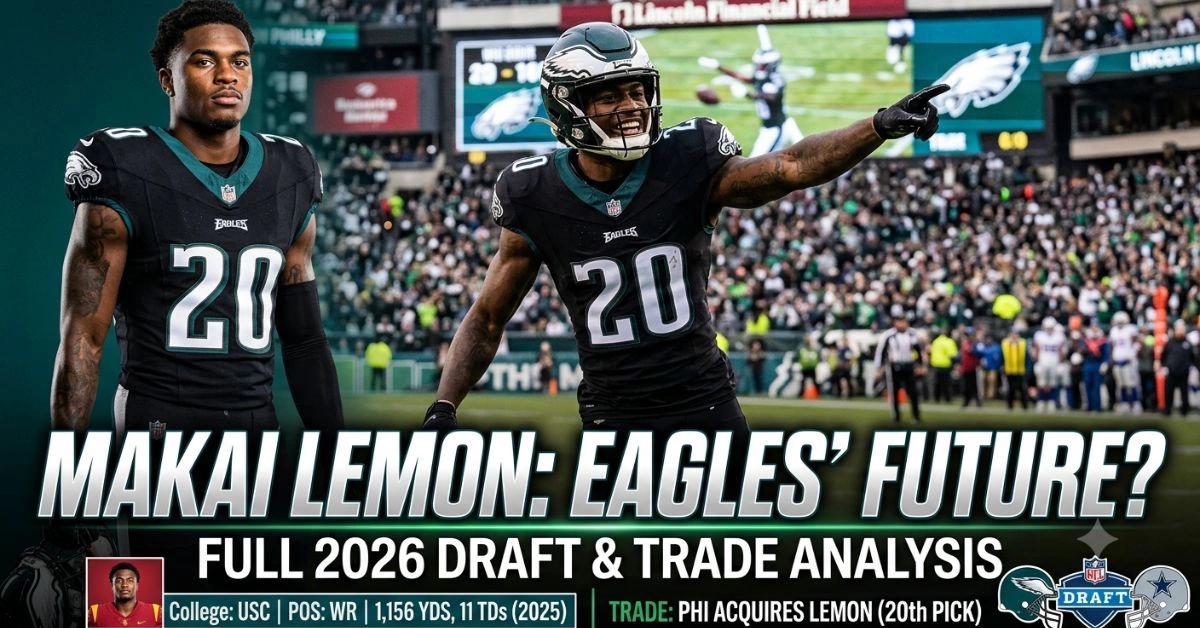
The Philadelphia Eagles made one of the more decisive moves of the 2026 NFL Draft when they traded up three spots to select USC wide receiver Makai Lemon with the 20th overall pick. This Eagles rookie trade wasn’t just about adding talent—it was a calculated response to the departure of A.J. Brown and a statement about building around Jalen Hurts with speed, reliability, and versatility in the passing game.
Howie Roseman and the front office surrendered their original 23rd pick, plus two fourth-round selections (114 and 137), to the Dallas Cowboys to move up and secure Lemon, while also gaining a 2027 seventh-rounder in return. It was a classic Eagles maneuver: aggressive but not reckless, targeting a player who sat atop their board.
This article breaks down the background of the trade, Lemon’s college production and scouting profile, how he fits into the current Eagles offense and roster, the financial and cap implications, tactical breakdowns, historical context from past Eagles draft and trade strategies, and projections for his rookie season and beyond. We’ll also look at broader roster building and what this means for Philadelphia’s contention window.
Trade Background: Why the Eagles Moved Up
By the time the 2026 draft rolled around, the Eagles had already undergone significant offseason changes. The trade of A.J. Brown to the New England Patriots for future picks created a clear need for proven playmakers who could stretch the field and work the middle. DeVonta Smith remained the alpha, but the supporting cast needed an infusion of youth and explosiveness.
Rumors swirled pre-draft that Lemon was a top-15 player on Philly’s board. Sitting at 23, they watched a few teams ahead potentially eyeing receivers or other positions. Moving up to 20 with the rival Cowboys was poetic—stealing a potential star from under Dallas’s nose while costing them mid-round capital they could afford to part with. The Cowboys took UCF edge rusher Malachi Lawrence at 23, but the consensus around the league was that Philly got the better end of the deal for a polished, productive receiver.
This wasn’t the only trade activity. The Eagles also acquired veteran edge help in Jonathan Greenard and made other maneuvers, but the Lemon selection stood out as the marquee rookie addition. It signaled a commitment to the passing game amid questions about the offensive line aging and the need for weapons that fit Hurts’ strengths—quick releases, contested catches, and yards after contact.
Player Profiling: Makai Lemon’s College Career and Traits
Makai Lemon arrived at USC as a versatile athlete and left as the 2025 Biletnikoff Award winner, recognizing the nation’s top receiver. Over three seasons (33 games), he posted 137 receptions for 2,008 yards and 14 touchdowns, averaging 14.7 yards per catch. His junior year exploded: 79 catches for 1,156 yards and 11 scores in 12 games, showing consistency and big-play ability.
At 5’11”, 195 pounds, Lemon doesn’t have elite size, but he plays bigger than his frame suggests. Scouts praised his strong hands, body control in contested situations, and ability to win at all three levels of the route tree. He was sudden off the line, reliable in the slot, and showed toughness running through traffic. Drop rate was low—only a handful over his final two seasons—and he converted a high percentage of contested targets.
His production wasn’t empty stats in a spread system; he delivered against quality competition and elevated his game in 2025 as the focal point of the USC offense. Add in special teams contributions earlier in his career (kick returns), and you get a player with immediate NFL utility beyond just lining up wide.
Key Strengths:
- Elite ball skills and catch radius adjustment for his size.
- Quick-twitch release and route precision.
- YAC potential and physicality after the catch.
- Low drops and high football IQ.
Areas to Watch:
- Limited length may cap him against bigger corners in press coverage.
- Refining route nuances against NFL speed and length.
- Durability over a full 17-game slate plus playoffs.
Lemon projects as a high-floor, high-ceiling slot/outside hybrid who can complement DeVonta Smith perfectly.
Data Comparison: Lemon vs. Eagles Receivers and Peers
Here’s a side-by-side look at Lemon’s final college season against key current Eagles receivers and a couple of comparable 2026 rookie/draft peers (using 2025 college or recent pro production where applicable for context):
| Player | Team/Year | Receptions | Yards | Avg | TDs | Games | Notable Traits |
| Makai Lemon | USC 2025 | $79 | $1,156 | 14.6 | 11 | 12 | Biletnikoff winner, contested catch specialist |
| DeVonta Smith | PHI (Pro) | ~80+ (proj. similar volume) | High 1,000s | ~14+ | 8-10 | 17 | Established WR1, route technician |
| Hollywood Brown | PHI (Pro) | Veteran speedster | Speed-focused | Varies | Mid | 17 | Deep threat complement |
| Dontayvion Wicks | PHI (Acq.) | College/Pro hybrid | Strong YAC | 13-15 | Solid | – | Athletic mismatch |
| Johnny Wilson | PHI | Developmental | Size/speed | – | – | – | Big target upside |
| Comparable: Top WR Prospect Peer (e.g., hypothetical similar) | College 2025 | 60-75 | 900-1,100 | 14+ | 8-10 | 12 | – |
This table highlights Lemon’s standout production relative to his class and how he slots in without overlapping too heavily with Smith’s skill set. His efficiency and touchdown rate stand out.
Tactical Fit in the Eagles Offense
Under Nick Sirianni and the offensive coordinators, the Eagles have favored a run-heavy base with explosive play-action and RPO elements that suit Hurts. Lemon fits as a movable piece who can align in the slot, motion across formations, and create mismatches.
His route-running complements Smith’s precision and the deep speed from players like Hollywood Brown or Dontayvion Wicks. Expect packages where Lemon works underneath and intermediate routes, punishing linebackers and safeties in coverage while opening lanes for Saquon Barkley and the run game.
In 2026, with veterans like Elijah Moore and others providing depth, Lemon won’t be forced into a featured role immediately, which aids development. Coaches have raved about his football character and willingness to block and contribute in all phases—traits that endear rookies to the Eagles’ culture.
For fans wanting to catch every snap, modern IPTV options like those reviewed on TVLio IPTV make streaming live NFL games seamless across devices.
Financial and Cap Space Impact
Rookie contracts in the NFL are slotted, so Lemon’s deal is predictable—around four years with a fifth-year option. His cap hit in 2026 will be manageable, likely in the low millions, freeing resources elsewhere. This Eagles rookie trade preserved flexibility compared to signing a veteran free agent at similar production level.
Post-Brown trade, cap space opened up. Investing in a high-pedigree rookie like Lemon aligns with Roseman’s history of building through the draft while mixing in savvy veteran acquisitions. It avoids overpaying for production that a first-round talent can provide after year one.
Historical Eagles Draft and Trade Context
Philadelphia has a mixed but often successful history with first-round receivers. Smith was a home run. Earlier moves like trading up or acquiring talent (think past WR additions) show a pattern: identify specific needs and strike when value aligns.
The 2026 class also included other rookies like TE Eli Stowers and OT Markel Bell, plus the Greenard trade, showing a balanced approach. This rookie move stands out for its immediacy in addressing the WR room after losing a star.
Future Projections and 2026 Outlook
Realistic expectations for Lemon’s rookie year: 50-70 receptions, 700-1,000 yards, and 5-8 touchdowns if he earns consistent targets. With Hurts’ accuracy and the offensive weapons around him, he could exceed that in favorable matchups.
Longer term, he has WR1 upside in the right system. Durability, scheme adaptation, and chemistry with Hurts will determine if he becomes a cornerstone or solid No. 2/3.
Injuries, offensive line play, and defensive attention will factor in. But the talent and fit suggest a positive impact on Philly’s playoff push.
Broader Roster Building and Tech in Sports
The Eagles’ approach reflects modern NFL trends: data-driven evaluations, trading for specific fits, and leveraging technology. Advanced roster building tools and apps, similar to platforms reviewed in guides like the BLDR AI full-stack app builder, help front offices simulate scenarios and optimize decisions.
For stats and simulations, fans turn to sports gaming like those on aitrender.net/games to model outcomes, including Madden runs projecting Lemon’s integration. Technical data tracking in 2026, as explained in resources like What is TransDS?, enhances scouting and in-game adjustments with better streaming and analytics.
Potential Challenges and Adjustments
No prospect is without hurdles. Lemon will face NFL corners with superior length and speed. Early reps might include some target share battles with veterans. Special teams could see him early while he learns the pro game.
Coaching staff will likely emphasize fundamentals and playbook mastery. Preseason and training camp will be telling—watch for chemistry in the red zone and third downs.
Why This Trade Strengthens the Eagles
This Eagles rookie trade adds youth, talent, and depth without breaking the bank or mortgaging future assets excessively. It positions Philadelphia to compete in a tough NFC East while building for sustainability.
Fans should be excited: a dynamic receiver entering a quarterback-friendly system with proven veterans to learn from. The move embodies smart, aggressive roster management that has defined successful Eagles teams.
FAQS
1. What exactly did the Eagles give up in the Makai Lemon trade?
They sent the 23rd pick, plus fourth-rounders 114 and 137, to Dallas for the 20th pick and a future seventh. It was a reasonable price for a top prospect.
2. How does Makai Lemon compare to DeVonta Smith?
Lemon brings similar reliability but more slot versatility and YAC burst. Smith is the established alpha; Lemon complements rather than replaces.
3. Will Lemon start as a rookie for the Eagles?
He’ll rotate heavily and likely start in certain packages or when matchups favor him. Depth allows a ramp-up period.
4. Did the Eagles make other big trades around the 2026 draft?
Yes, including acquiring Jonathan Greenard and other veteran moves to bolster the roster.
5. What are realistic stats for Lemon in 2026?
Expect solid contributor numbers in the 600-900 yard range with room to grow as he earns trust.