



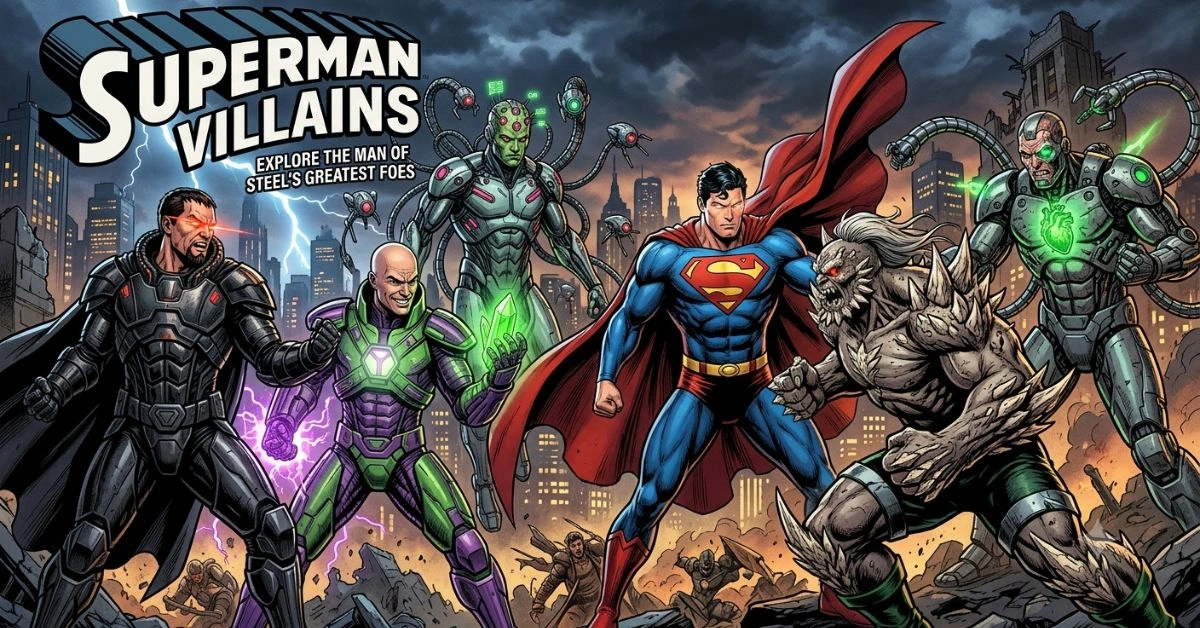
Superman stands as a beacon of hope in a world that often feels chaotic. Yet his story gains depth from the adversaries who challenge not just his strength but his ideals. The best Superman villains force him to question what it means to be human, to protect the innocent, and to hold onto morality when power could easily corrupt. These characters have evolved over decades, reflecting societal fears, technological anxieties, and timeless human flaws.
From cunning industrialists to unstoppable alien threats, Superman’s rogues gallery offers variety that matches the hero’s own multifaceted existence. This guide examines their histories, motivations, and lasting influence, drawing from comic lore, adaptations, and the psychological layers that make them memorable.
The Evolution of Superman’s Enemies Through the Decades
Superman debuted in 1938’s Action Comics #1, created by Jerry Siegel and Joe Shuster. Early threats were often mad scientists or gangsters, mirroring the pulp fiction of the era. As the Golden Age progressed, villains became more fantastical.
The Silver Age (1950s-1960s) introduced whimsical and sci-fi elements. Mr. Mxyzptlk, the imp from the fifth dimension, brought chaos with his reality-bending pranks, first appearing in Superman #30 (1944) but becoming a staple later. Bizarro emerged as a flawed duplicate, highlighting themes of identity and imperfection.
The Bronze Age and beyond darkened the tone. Lex Luthor solidified as the intellectual counterpoint to Superman’s might. Cosmic threats like Darkseid arrived, expanding the scope to multiversal stakes. Modern stories explore moral ambiguity, redemption arcs, and the consequences of power.
This progression mirrors broader comic book trends: from straightforward good-versus-evil battles to nuanced explorations of heroism. Superman villains rarely stay static; they adapt, reflecting changes in how we view authority, technology, and alien “others.”
Lex Luthor: The Archetypal Human Antagonist
No discussion of Superman villains starts anywhere but with Lex Luthor. Bald, brilliant, and utterly ruthless, Luthor embodies humanity’s potential for both greatness and destruction. His hatred stems not from personal loss in all versions but from a deep-seated belief that Superman undermines human achievement.
In classic origins, a young Lex’s lab accident—sometimes involving Superboy—leads to permanent baldness and resentment. Post-Crisis continuity refined him into a self-made billionaire who sees Superman as an alien interloper threatening Earth’s sovereignty. He funds weapons, runs for president, and orchestrates schemes that test Superman’s limits without direct confrontation.
Luthor’s psychology fascinates. He represents unchecked ego and the fear of obsolescence. Where Superman inspires, Luthor manipulates. His intellect rivals any hero’s, using Kryptonite, robots, and political influence. Key stories like “Whatever Happened to the Man of Tomorrow?” and his role in Infinite Crisis showcase his strategic depth.
In adaptations, Gene Hackman brought campy flair, while Michael Rosenbaum’s Smallville version added tragic layers. Jesse Eisenberg portrayed a tech-bro iteration. Across mediums, Luthor forces Superman to confront whether power alone defines worth.
General Zod: Kryptonian Supremacy and Betrayal
General Dru-Zod personifies militaristic ambition among Kryptonians. Imprisoned in the Phantom Zone for attempting a coup, Zod emerges with powers equal to Superman’s under Earth’s yellow sun. His mantra—”Kneel before Zod”—captures authoritarian control.
Zod’s backstory ties to Krypton’s rigid society. As a military leader, he believed in survival through strength, clashing with the Science Council. Released on Earth, he seeks to conquer or rebuild a new Krypton, often endangering humans. His relationship with Superman mixes respect and disdain; both share heritage, but Zod rejects compassion.
Terrence Stamp’s icy portrayal in the Christopher Reeve films defined the character for generations. Michael Shannon brought intensity to Man of Steel. Stories like “The Last Son” explore family dynamics with Zod’s son, adding emotional weight.
Zod challenges Superman’s identity. As a survivor of the same doomed planet, he questions why Kal-El embraces Earth over Kryptonian legacy. Battles against Zod highlight the tension between heritage and chosen family.
Brainiac: The Cold Collector of Worlds
Brainiac stands apart as an alien intelligence driven by data acquisition. Originally a green-skinned humanoid, later iterations depict him as a robotic entity or cyborg with a 12th-level intellect. He shrinks cities, bottling them for his collection, and views organic life as inferior.
His origins trace to pre-Crisis as a space pirate or Coluan scientist. Post-Crisis, he serves as a probe for an ancient entity. Brainiac’s invasions threaten Metropolis and beyond, often allying with Luthor for mutual gain.
Psychologically, Brainiac represents technological dehumanization. He lacks emotion, calculating probabilities while erasing cultures. Encounters force Superman to blend brute force with strategy, as raw power alone rarely suffices.
In animation and games, Brainiac’s multiple bodies and adaptability make him a persistent threat. His role in Superman: Brainiac storyline delves into Kryptonian history, revealing connections to the planet’s fall.
Doomsday: The Monster That Killed Superman
Doomsday’s arrival in the 1990s “Death of Superman” event shocked readers. A hulking, bone-spiked creature with adaptive evolution, he rampaged across America, ultimately killing Superman in a brutal melee.
Comic origins depict Doomsday as a Kryptonian experiment. A scientist subjected a being to repeated death and resurrection, forging ultimate survival instincts. He hates all life, driven by primal rage.
Adaptations vary. The DCEU version combined Zod’s corpse with Lex Luthor’s DNA, creating a hybrid. This ties personal vendettas to larger consequences. Doomsday forces Superman to sacrifice everything, proving even the invincible have limits.
His regenerative abilities and resistance to previous weaknesses make rematches tense. Beyond physical threat, Doomsday symbolizes uncontrollable destruction, contrasting Superman’s restraint.
Other Notable Threats in the Rogues Gallery
Superman faces diverse foes beyond the heavy hitters. Metallo, a cyborg with a Kryptonite heart, exploits Superman’s vulnerability while grappling with lost humanity. The Parasite drains life force, turning victims into husks and mirroring fears of exploitation.
Bizarro, the imperfect clone, creates chaotic mirror scenarios. His “opposite” logic leads to well-intentioned disasters. Toyman blends whimsy with deadly toys, reflecting corrupted innocence. Livewire, an energy being, brings technological and media angles.
Mr. Mxyzptlk adds levity. Pronouncing his name backward banishes him, but his reality-warping tests Superman’s patience and creativity. Darkseid, the Lord of Apokolips, elevates stakes to god-like tyranny, seeking the Anti-Life Equation.
Lesser-known characters like Mongul (ruthless warlord of Warworld) and the Prankster (gadget-using trickster) fill niche roles. Groups such as Intergang bring organized crime with advanced tech.
Comparative Overview of Key Superman Villains
| Villain | First Appearance | Primary Power/Threat | Creator(s) | Psychological Angle |
| Lex Luthor | Action Comics #23 (1940) | Genius intellect, resources | Siegel & Shuster | Ego, fear of inferiority |
| General Zod | Adventure Comics #283 (1961) | Kryptonian powers, leadership | Siegel & Shuster | Authoritarianism, betrayal |
| Brainiac | Action Comics #242 (1958) | 12th-level intellect, collection | Otto Binder & Al Plastino | Dehumanization, cold calculation |
| Doomsday | Superman: The Man of Steel #17 (1992) | Adaptive strength, rage | Dan Jurgens | Primal destruction, inevitability |
| Metallo | Action Comics #252 (1959) | Kryptonite radiation, cyborg | Robert Bernstein & Al Plastino | Lost humanity, vengeance |
| Mr. Mxyzptlk | Superman #30 (1944) | Reality warping | Jerry Siegel & John Sikela | Chaos, whimsy |
This table highlights diversity in threats, from mental to physical.
Themes and Symbolism in Superman Villains
Superman villains often mirror aspects of the hero or society. Luthor critiques blind faith in saviors. Zod questions assimilation versus dominance. Brainiac warns against unchecked progress. Doomsday embodies nature’s fury against civilization.
These conflicts explore identity, especially for an immigrant hero like Kal-El. Many villains exploit Kryptonite or magic, bypassing physical superiority and demanding clever solutions. Psychological battles prove as compelling as fistfights.
Redemption appears occasionally. Some Bizarro versions show loyalty, and certain Zod iterations seek uneasy alliances. Yet core antagonism persists, keeping the dynamic fresh.
Superman Villains in Media and Pop Culture
Comics remain the foundation, but films, TV, and games amplify reach. The Reeve-era movies cemented Luthor and Zod. Animated series like Superman: The Animated Series delivered strong Brainiac arcs. Recent films blend elements, sometimes controversially.
Fans seeking classic cartoons, movies, or live TV channels often turn to reliable streaming options for comprehensive access. Services like those reviewed at TVLio IPTV provide extensive libraries of superhero content without interruptions.
Gadgets play recurring roles. Heroes and villains alike rely on technology. In one memorable tale, a simple utility like knowing how to turn phone flashlight off in critical moments parallels resourcefulness under pressure—reminding us that even in epic battles, practical knowledge saves the day.
Video games let players battle these foes directly, while merchandise keeps them visible. Their influence extends to broader discussions on power, ethics, and heroism.
Why Superman Villains Endure
These characters succeed because they challenge Superman’s core—optimism amid adversity. They aren’t mere obstacles but catalysts for growth. Readers see reflections of real-world tyrants, technocrats, and monsters.
The rogues gallery’s strength lies in balance: intellectual, physical, cosmic, and personal threats. Writers continue mining new angles, ensuring relevance.
FAQ: Common Questions About Superman Villains
1. Who is Superman’s archenemy?
Lex Luthor holds that title. His human perspective and personal vendetta create the most consistent rivalry.
2. What is Doomsday’s origin?
In comics, experiments on ancient Krypton created an unstoppable survivor. Adaptations often tie him to Zod or Lex.
3. Can any Superman villain beat him?
Yes. Doomsday kills him, Brainiac outthinks him at times, and magic or Kryptonite levels the field. Victory usually requires allies or strategy.
4. Who is the strongest Superman villain?
Debates rage, but Doomsday, Darkseid, and Mongul rank high in raw power. Intellect favors Luthor or Brainiac.
5. Are there female Superman villains?
Yes, including Faora, Ursa, Livewire, and Silver Banshee. They add diverse dynamics.
6. How do Superman villains compare to Batman’s?
Superman emphasizes power and ideology on grand scales. Batman’s focus on psychology and street-level crime. Both galleries complement their heroes.
7. Has Superman ever teamed up with his villains?
Occasionally, against greater threats like Darkseid or world-ending crises. These uneasy alliances highlight pragmatism.
This exploration barely scratches decades of stories. Superman villains define his legend as much as his victories. They remind us that strength without purpose falters, and true heroism lies in unwavering principles.