


Europe stands at a pivotal moment, with countless initiatives shaping its infrastructure, economy, environment, and technological landscape. From massive rail networks connecting distant regions to research collaborations tackling climate change, these efforts reflect a continent-wide push toward resilience, innovation, and sustainability. Whether you’re a policymaker, investor, business professional, or simply curious about how Europe evolves, understanding these active endeavors provides valuable context for the changes unfolding across member states.
“European Active Projects” encompasses a broad spectrum of endeavors, ranging from specialized contracting work in marine and industrial sectors to large-scale EU-funded programs in transport, energy, and science. This article examines the most significant ones, their progress, challenges, and broader implications.
The Scope of European Active Projects Today
Active projects in Europe span multiple domains, backed by substantial public and private funding. The European Union plays a central role through programs like Horizon Europe, the Recovery and Resilience Facility, and the European Green Deal, which together mobilize hundreds of billions of euros. These initiatives address pressing needs: modernizing aging infrastructure, reducing carbon emissions, fostering digital transformation, and ensuring economic cohesion across regions.
In construction and engineering, companies like European Active Projects contribute hands-on expertise, particularly in marine environments, ship repairs, and industrial fabrication. Their work supports critical maintenance and development across UK and EU ports, helping keep vital trade routes operational.
Broader efforts include high-speed rail links, offshore wind farms, CO2 transport networks, and research into advanced materials and AI applications. As of 2026, the construction sector shows signs of recovery after earlier slowdowns, driven by public investments in green and digital transitions.
Major Infrastructure Developments
Infrastructure forms the backbone of many European active projects. Several megaprojects stand out for their scale and strategic importance.
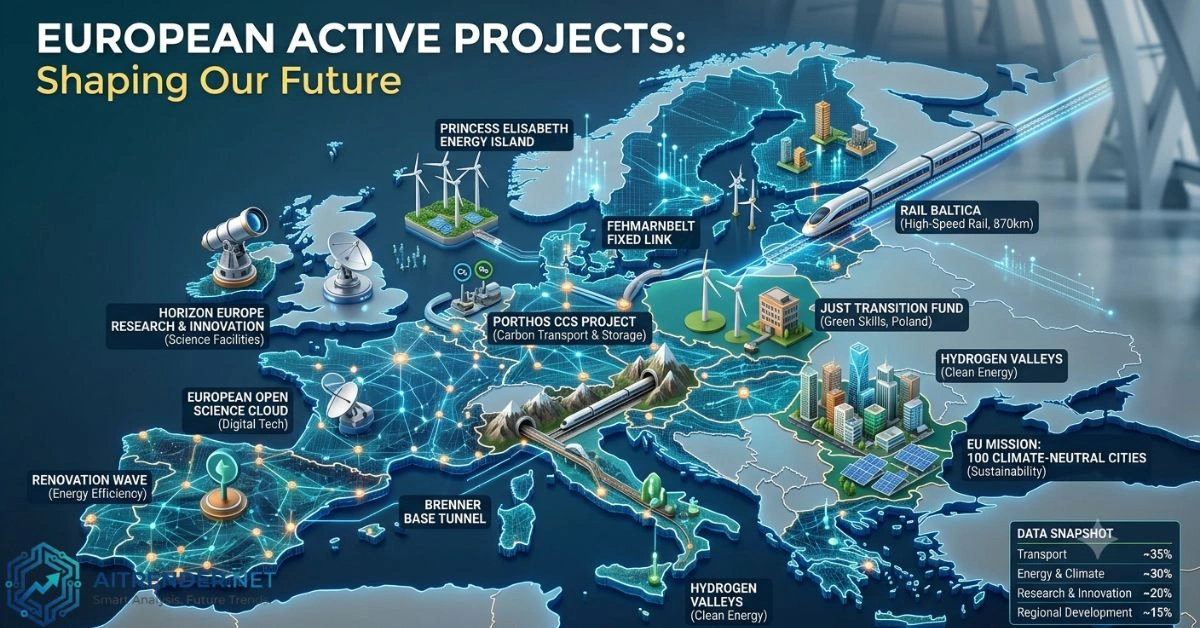
Rail Baltica represents one of the most ambitious transport undertakings. This 870-kilometer high-speed rail line will connect Estonia, Latvia, Lithuania, and Poland, integrating the Baltic states into the broader European rail network. With over €5 billion in EU co-financing, it promises faster passenger and freight movement, economic boosts, and reduced road dependency. Progress includes station developments and track laying, with full operations targeted around 2030. Challenges involve cross-border coordination and environmental considerations, but the project advances steadily.
The Fehmarnbelt Fixed Link between Denmark and Germany is another landmark. This immersed tunnel will shorten travel times dramatically once completed, enhancing connectivity in Northern Europe. Construction milestones in recent years highlight engineering feats in challenging underwater conditions.
In the Alps, the Brenner Base Tunnel continues as one of Europe’s longest rail tunnels, aimed at shifting freight from roads to rails and easing congestion on key corridors. These projects exemplify how European active projects prioritize sustainable mobility.
Beyond rail, road and port upgrades feature prominently. In the Netherlands and Belgium, major ring road and port expansions support growing trade volumes while incorporating green technologies. Offshore energy hubs, such as Princess Elisabeth Island, combine infrastructure with renewable energy generation.
Energy Transition and Green Initiatives
The European Green Deal drives numerous active projects focused on climate neutrality by 2050. Investments target renewable energy, energy efficiency, and decarbonization.
Offshore wind farms have expanded rapidly. Projects in the North Sea and Baltic Sea add gigawatts of capacity, supported by dedicated infrastructure like energy islands. CO2 transport and storage initiatives, such as the Porthos pipeline in Rotterdam, mark early steps toward carbon capture and storage (CCS) at scale. These systems will handle millions of tonnes annually, helping hard-to-abate industries.
The Just Transition Fund supports regions dependent on fossil fuels, funding retraining, new industries, and infrastructure. In places like Eastern Wielkopolska in Poland, projects create jobs in hydrogen production and clean technologies.
Renovation waves target buildings, aiming to double renovation rates. EU funds back deep retrofits for schools, hospitals, and homes, improving energy performance and living standards.
Hydrogen valleys and battery manufacturing hubs emerge as part of the clean industrial strategy. These European active projects not only cut emissions but also strengthen supply chain security and create employment.
Research and Innovation Under Horizon Europe
Horizon Europe, with its €95.5 billion budget, funds thousands of collaborative research efforts. These European active projects tackle health, climate, digital technologies, and more.
Research infrastructures receive significant attention, supporting access to advanced facilities for scientists across disciplines. Topics include AI for science, sustainable instrumentation, and data services via the European Open Science Cloud.
Partnerships in clean aviation, hydrogen, rail, and batteries bring industry and academia together. Missions under Horizon Europe address specific challenges like climate adaptation in cities, healthy oceans, and soil health.
Examples include projects on multi-hazard risk management, coastal climate services, and critical infrastructure resilience. These efforts generate actionable knowledge, technologies, and policies that feed into implementation on the ground.
International dimensions, such as Global Gateway, extend European expertise in sustainable infrastructure to partner countries, focusing on digital, energy, and transport links.
The Role of Specialized Contractors in European Active Projects
While high-level policies and funding grab headlines, execution depends on skilled operators. Firms specializing in marine and industrial work play essential supporting roles. European Active Projects, for instance, delivers fabrication, repairs, and labor solutions for shipyards, ports, and industrial sites. Their involvement in Royal Navy vessel maintenance and commercial contracts demonstrates reliability in demanding environments.
Such expertise ensures that larger initiatives stay on track. From welding and plating to environmental works with agencies, these contributions keep supply chains moving and infrastructure functional.
Economic and Social Impacts
European active projects generate wide-ranging benefits. They create jobs—often in high-skill areas—stimulate local economies, and foster innovation ecosystems. Data centers, life sciences facilities, and renewable manufacturing attract further investment.
Socially, they promote inclusion through just transition measures and accessible infrastructure. However, challenges persist: permitting delays, skills shortages, rising costs, and geopolitical uncertainties can slow progress.
Success depends on streamlined regulations, public-private partnerships, and community engagement. Monitoring and evaluation frameworks help ensure funds deliver intended outcomes.
Challenges and Future Outlook
Despite momentum, obstacles remain. Inflation, supply chain disruptions, and regulatory complexity affect timelines. Climate adaptation adds another layer, requiring projects to withstand extreme weather.
Looking ahead, 2026 and beyond signal renewed growth in construction and related sectors. Emphasis on digital twins, AI optimization, and circular economy principles will shape the next wave of European active projects. Integration of biodiversity considerations and social metrics will become standard.
Investors and businesses can participate through tenders, consortia, or regional programs. Staying informed about open calls on EU portals proves valuable.
Internal Link Example Section Integration: For those interested in tools supporting mental well-being amid fast-paced project environments, exploring meditation gadgets offers practical options for professionals involved in demanding European active projects. Similarly, narrative-driven insights from series like The Inheritance Games can provide engaging parallels to strategic planning and long-term visioning in complex multi-stakeholder initiatives.
Data Snapshot: Key Sectors in European Active Projects
While specific aggregated tables vary by source, indicative breakdowns show heavy focus on:
- Transport: ~30-40% of major infrastructure spend
- Energy and Climate: Significant share via Green Deal allocations
- Research & Innovation: Horizon Europe disbursements across clusters
- Regional Development: Cohesion policy funds
These figures underscore prioritization of connectivity and sustainability.
How Individuals and Businesses Can Engage
Opportunities abound. Researchers can join consortia for Horizon calls. Contractors bid on tenders. Local authorities access funds for community projects. Platforms like the EU Funding & Tenders Portal list active opportunities.
Networking at industry events and monitoring national recovery plans helps identify entry points.
FAQs
1. What are European active projects?
They refer to ongoing initiatives across Europe in infrastructure, energy, research, environment, and industry, often supported by EU funding or private efforts. This includes everything from rail megaprojects to specialized marine contracting work.
2. How does the EU fund these projects?
Primarily through Horizon Europe, the Recovery and Resilience Facility, Cohesion Funds, and the Green Deal mechanisms. Public-private partnerships and national budgets supplement EU contributions.
3. Which sectors have the most activity?
Transport infrastructure, renewable energy, climate adaptation, and digital/research technologies lead, with strong emphasis on decarbonization and connectivity.
4. What challenges do these projects face?
Delays from permitting, cost overruns, skills gaps, and coordination across borders. Geopolitical factors and material shortages also play roles.
5. How can I learn about specific opportunities?
Check the EU Funding & Tenders Portal, national contact points, and industry associations. Company sites like those of specialized contractors provide insights into implementation.
6. Are these projects on track for 2030 and 2050 goals?
Progress varies. Many advance well in renewables and rail, but accelerated efforts are needed in buildings, industry decarbonization, and full network integration to meet targets.