



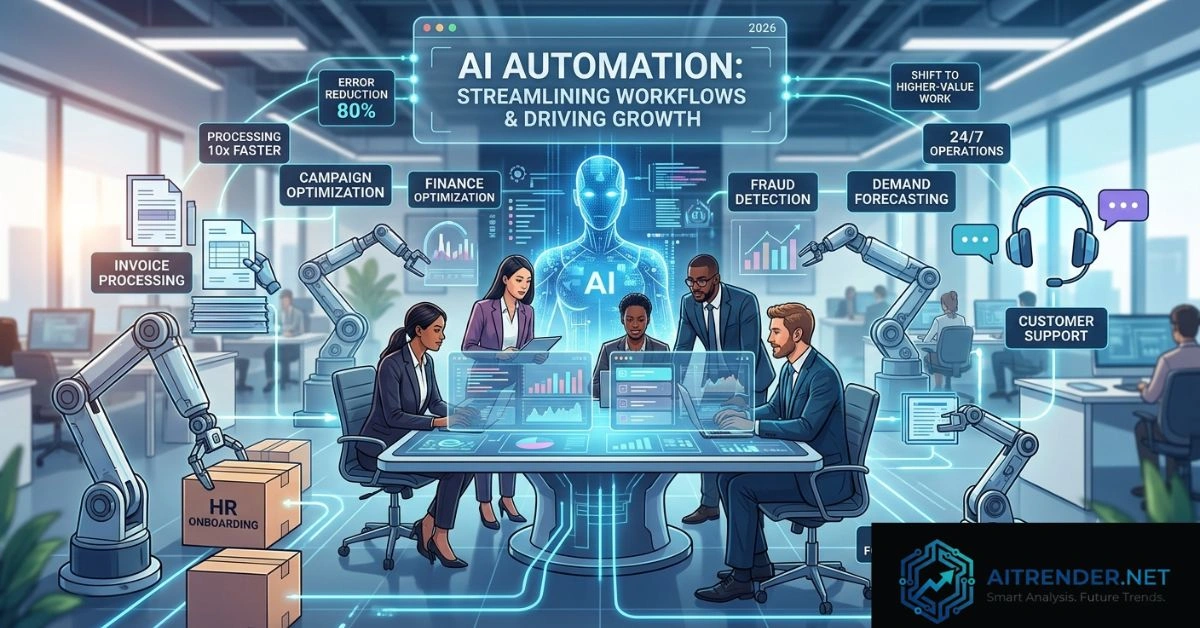
AI automation has moved past the hype. Companies now use it to handle repetitive work, make faster decisions, and let people focus on what machines still can’t do well. If you’re running a business or managing teams, understanding AI automation isn’t optional anymore—it’s how you stay competitive without burning out your staff.
This guide breaks down exactly what it looks like today, where it delivers the biggest wins, how to get started without wasting money, and the real risks you need to manage.
What AI Automation Actually Means Today
AI automation combines traditional automation tools—like scripts or robotic process automation (RPA)—with artificial intelligence that can handle uncertainty, learn from data, and make judgments. Classic automation follows strict if-then rules. AI versions adapt when things change.
Think of it this way: a basic script might extract data from invoices if the format never varies. An AI system reads messy scanned PDFs, understands context, flags unusual items, and routes them for review automatically.
In 2026, the big shift is toward agentic AI—systems that don’t just follow one command but plan multi-step processes, use tools, and adjust based on outcomes. Multi-agent setups let specialized AIs collaborate, like one handling research while another executes tasks and a third reviews for errors.
This matters because most business work isn’t simple repetition. It involves emails with attachments, changing customer requests, or incomplete data. AI automation tackles those gray areas.
Why Businesses Adopt AI Automation Now
The numbers tell a clear story. Teams report processing speeds 10-100x faster on automated tasks, error rates dropping 80-90%, and the ability to run 24/7 without fatigue. Costs drop in areas like invoice processing or customer support, while employees shift to higher-value work.
Beyond metrics, it changes daily operations. Managers spend less time chasing updates and more on strategy. Small teams compete with larger ones by scaling processes without hiring proportionally.
Entrepreneurs building sustainable businesses particularly benefit. Automated systems free up time for creative problem-solving and long-term planning, creating clarity and focus that supports growth without constant firefighting. For a deeper look at how this fits into building resilient operations, check out this complete guide on clarity, focus, and sustainable entrepreneurship.
Key Technologies Powering AI Automation
Several layers work together:
- Large Language Models (LLMs) like those behind ChatGPT, Claude, or Gemini handle natural language, document understanding, and generation.
- RPA platforms (UiPath, Automation Anywhere) manage structured interactions with legacy systems.
- Workflow orchestration tools (Zapier, n8n, Make) connect apps and trigger actions.
- Agent frameworks enable autonomous planning and tool use.
- Computer vision and NLP process images, videos, and unstructured text.
Hyperautomation combines these for end-to-end processes across departments.
Real-World Use Cases That Deliver Results
Customer Service
AI chatbots and agents handle initial inquiries, triage issues, and escalate complex cases. They pull customer history, suggest solutions, and update records. Companies see faster resolution times and happier agents who tackle tough problems.
Finance and Accounting
Invoice processing, reconciliation, fraud detection, and expense reports. AI extracts data from varied formats, matches payments, and flags anomalies with high accuracy. Loan processing speeds up dramatically while cutting manual review needs.
HR and Operations
Resume screening, onboarding, payroll verification, and employee queries. Predictive maintenance in manufacturing uses sensor data to schedule repairs before breakdowns occur.
Sales and Marketing
Lead qualification, personalized outreach, content generation, and campaign optimization. AI agents analyze behavior and trigger follow-ups at the right moments.
Supply Chain and Logistics
Demand forecasting, route optimization, and inventory management. Digital twins simulate operations for better planning.
These aren’t theoretical. Organizations run them in production, measuring ROI through time saved and error reduction.
Step-by-Step: How to Implement AI Automation
Getting started doesn’t require a massive IT overhaul. Follow a practical sequence:
- Audit Your Current Processes Track where your team spends the most time. Look for repetitive, rule-based, or data-heavy tasks with clear inputs and outputs. Prioritize high-volume, error-prone ones.
- Define Clear Goals and Success Metrics Tie automation to business outcomes—hours saved, cost reduction, faster turnaround. Involve stakeholders early.
- Map the Process Document the current (“as-is”) flow, then design the improved (“to-be”) version. Identify decision points where AI adds value.
- Choose Tools That Fit Start simple with no-code options like Zapier or n8n for quick wins. Scale to UiPath, Microsoft Power Automate, or custom agents for complexity. Consider data privacy and integration needs.
- Build, Test, and Iterate Start with a pilot on one process. Test thoroughly with real and edge-case data. Add human oversight for exceptions.
- Train Your Team and Establish Governance Show people how to work alongside the systems. Set policies for monitoring, data handling, and updates.
- Measure, Scale, and Maintain Track metrics continuously. Plan for model retraining as data changes. Expand to connected processes.
Many businesses begin with one workflow—like automating email responses or report generation—then build from proven results.
Popular AI Automation Tools in 2026
- Zapier and Make: Great for no-code connections between apps.
- n8n: Flexible, open-source-friendly workflow automation.
- UiPath: Strong for enterprise RPA with AI capabilities.
- Lindy and similar agent builders: For task-specific autonomous agents.
- Microsoft Power Automate: Integrates well within Microsoft ecosystems.
- Specialized platforms: Like those for testing, content, or industry verticals.
Evaluate based on your tech stack, team skills, and scale. Many offer free tiers to experiment.
Comparison of AI Automation Approaches
| Approach | Best For | Pros | Cons | Example Tools |
| No-Code Workflows | Small teams, quick wins | Fast setup, low cost | Limited complexity | Zapier, Make, n8n |
| RPA + AI | Structured enterprise tasks | Handles legacy systems | Can be brittle | UiPath, Automation Anywhere |
| Agentic Systems | Complex, multi-step work | Adaptive, goal-oriented | Higher setup, needs oversight | Custom agents, multi-agent frameworks |
| Industry-Specific | Regulated sectors | Compliance built-in | Less flexible | Vertical solutions in finance/healthcare |
This table helps match the right level to your needs without overcomplicating early efforts.
Challenges and Risks of Scaling AI Automation
AI doesn’t solve everything cleanly. Common hurdles include poor data quality, integration with old systems, and maintaining reliability as conditions change.
Governance stands out as a major issue. As automation scales, questions arise around accountability, bias, security, and compliance. Without proper controls, companies face regulatory risks, reputational damage, or flawed decisions. AI transformation often boils down to a problem of governance—deciding who oversees systems, how to audit them, and how to align with business values.
For deeper insight into these management challenges, especially on platforms like Twitter/X where discussions evolve rapidly, see this piece on why AI transformation is a problem of governance.
Other risks: job displacement in routine roles, over-reliance leading to skill atrophy, and high maintenance costs. Successful organizations treat automation as augmentation, keeping humans in the loop for judgment and creativity.
Address these upfront with clear policies, regular audits, and transparent processes.
The Future Outlook for AI Automation
Expect more multi-agent systems, tighter integration with physical operations (Physical AI), and hyper-personalization. Quantum computing may eventually boost capabilities, but practical gains come from better orchestration and governance today.
Businesses that design operations around automation-first thinking will pull ahead. Those treating it as a bolt-on will struggle with fragmented systems.
Frequently Asked Questions
1. What is the difference between RPA and AI automation?
RPA handles repetitive, rule-based tasks on existing interfaces. AI automation adds intelligence to interpret unstructured data, make decisions, and adapt—making it suitable for more variable work.
2. How much does AI automation cost to implement?
It varies widely. Simple no-code setups can start under a few hundred dollars monthly. Enterprise solutions run into thousands or more, plus internal time. Many see payback within months through labor savings and efficiency.
3. Will AI automation replace jobs?
It shifts roles. Routine tasks decline, while demand grows for oversight, strategy, and creative work. Companies that reskill teams thrive; others face disruption.
4. Is AI automation safe for sensitive data?
It can be, with proper controls. Choose tools with strong encryption, compliance certifications (GDPR, SOC 2, etc.), and on-premise or private options. Always audit data flows.
5. How do I measure ROI from AI automation?
Track time saved, error reduction, processing speed, cost per transaction, and employee satisfaction. Set baselines before implementation.
6. Can small businesses benefit from AI automation?
Absolutely. Start small with free or low-cost tools on high-impact tasks like email management or basic reporting. Many platforms scale with growth.
7. What skills do I need to get started?
Basic process thinking helps more than advanced coding. No-code tools lower the barrier, but understanding your workflows is key. Learning prompts and basic integration goes a long way.
AI automation isn’t a magic fix, but applied thoughtfully it delivers compounding advantages. Focus on solving real problems, maintain strong governance, and iterate based on results. Your next step: pick one painful process and automate it this week. The momentum builds from there.
For More Information Visit Aitrender.