



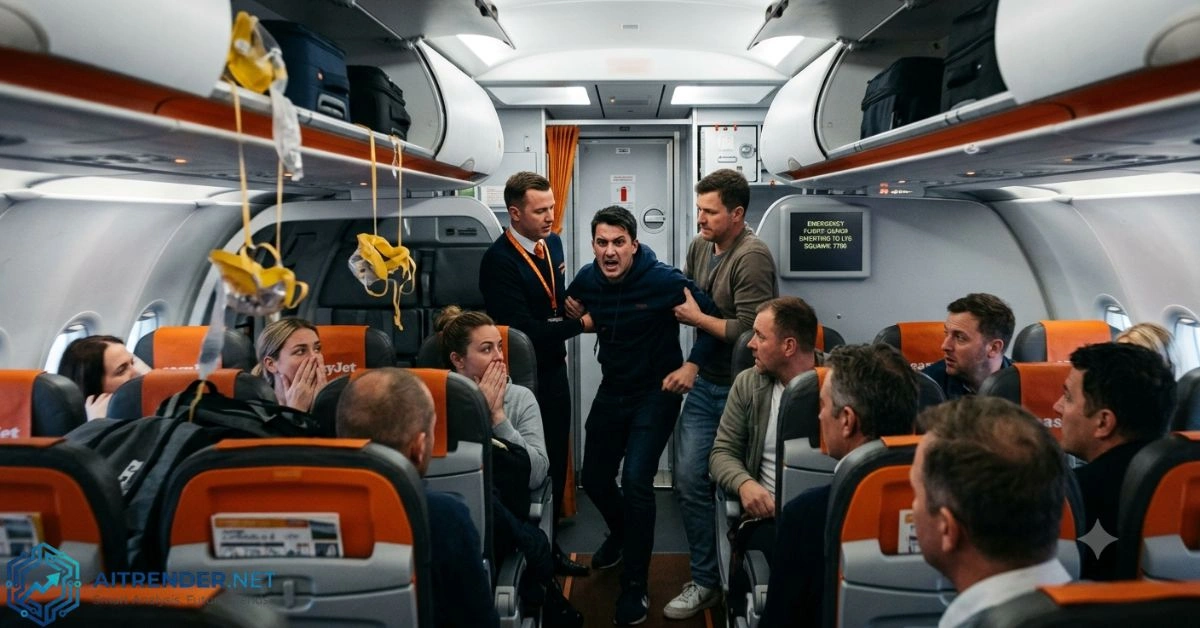
On August 22, 2025, an Airbus A320 operating easyJet flight U24429 from Lyon Saint-Exupéry Airport to Porto took off normally but soon found itself in the midst of a serious onboard crisis. The crew declared an emergency shortly after departure, squawking the universal distress code 7700 and turning back for a safe landing at the departure airport. What started as a routine short-haul flight turned into a tense situation involving a passenger in a psychotic state attempting to reach the cockpit.
This incident highlights the unpredictable nature of air travel and the rapid response capabilities built into modern aviation protocols. No one was seriously injured, and the aircraft later continued to its destination after the passenger was removed. But the event raised questions about passenger screening, crew training for unruly behavior, and the broader challenges low-cost carriers face in high-volume summer travel.
Comprehensive Breakdown of the Incident
Flight U24429 departed Lyon (LYS) around 18:34 CEST on August 22, 2025, already delayed by about an hour. The Airbus A320, registered OE-IJL, carried passengers bound for Porto, Portugal. Everything appeared standard during the initial climb.
Shortly after takeoff, as the aircraft reached approximately 20,000 feet, a 26-year-old Portuguese male passenger exhibited signs of acute distress. Reports describe him suffering from motion sickness that escalated into a full psychotic episode. He attempted to force his way toward the cockpit door. Fellow passengers and cabin crew quickly intervened, physically restraining him to prevent any breach of the secured flight deck.
The pilots declared an emergency, activated the transponder code 7700, and initiated a return to Lyon. The flight path showed a relatively quick turnaround. By 19:19 CEST, roughly 45 minutes after departure, the aircraft touched down safely on runway 35R at Lyon Saint-Exupéry. Emergency services were on standby, and the plane taxied to a remote stand for security and investigation.
French police met the aircraft. The passenger, not previously known to authorities, was taken into custody and later admitted to a hospital for psychiatric evaluation and treatment. He showed no signs of prior threats or terrorism links; it was a medical/psychological emergency that manifested violently in the confined space of an airliner.
After the situation was resolved and the passenger removed, the aircraft was cleared. easyJet operated the flight to Porto later that evening with the remaining passengers, minimizing further disruption where possible.
Timeline of Events
- Pre-departure: Flight delayed by one hour at Lyon.
- Takeoff: Approximately 18:34 CEST.
- Incident onset: Shortly after takeoff during climb.
- Emergency declaration: Crew squawks 7700; turn back initiated.
- Landing: 19:19 CEST at Lyon.
- Resolution: Passenger removed; flight eventually proceeds to destination.
The entire airborne phase lasted under an hour, demonstrating efficient handling under pressure.
Flight Details Summary
| Aspect | Details |
| Flight Number | U24429 (EJU4429 / EZY4429) |
| Aircraft Type | Airbus A320 (OE-IJL) |
| Origin | Lyon Saint-Exupéry (LYS) |
| Destination | Porto (OPO) |
| Diversion Airport | Lyon Saint-Exupéry (LYS) |
| Date | August 22, 2025 |
| Primary Reason | Passenger psychotic episode and attempted cockpit intrusion |
| Outcome | Safe return; no injuries reported; flight continued later |
This table captures the essential operational facts for quick reference.
Crew Response and Technical Aspects of the Emergency Diversion
easyJet pilots and cabin crew followed established procedures for in-flight security threats and medical emergencies. Once the passenger became agitated and moved aggressively forward, crew members used de-escalation techniques initially, then physical restraint with assistance from passengers. This collective action prevented escalation.
Pilots prioritized “land as soon as possible” over continuing to Porto. Declaring an emergency via squawk 7700 alerted air traffic control (ATC) immediately, granting priority handling. The short distance back to Lyon made a return the most logical choice—no fuel dumping was likely needed given the brief flight time.
The Airbus A320’s reinforced cockpit door, standard since post-9/11 regulations, remained secure. This incident underscores the effectiveness of hardened cockpit doors combined with crew vigilance.
In aviation, such events test the human element as much as the machine. Cabin crew receive regular training in conflict management, first aid, and restraint techniques. On this flight, their quick coordination with passengers turned a potential disaster into a contained event.
Standard Operating Procedures (SOPs) for Mid-Air Emergencies
Pilots train extensively for various scenarios, from technical failures to security issues. The “aviate, navigate, communicate” mantra guides actions: first fly the plane, then navigate to safety, and communicate with ATC and cabin crew.
For a passenger disturbance like this:
- Assessment: Crew evaluates the threat level.
- Containment: Secure the flight deck and restrain the individual if necessary.
- Declaration: If safety is compromised, declare emergency (Mayday or Pan-Pan, or squawk 7700).
- Diversion: Select the nearest suitable airport, considering runway length, medical facilities, and security.
- Post-landing: Coordinate with ground authorities.
Air traffic control plays a pivotal role. Upon receiving the 7700 signal, controllers clear airspace, provide vectors for approach, and alert emergency services. In Europe, systems like those managed by Eurocontrol ensure seamless coordination across borders, though this incident stayed within French airspace.
easyJet’s safety record remains strong overall. Like most major European low-cost carriers, it operates under strict EASA oversight. Diversions due to passenger behavior have increased industry-wide post-pandemic, linked to stress, alcohol, or untreated conditions. This case involved a genuine medical episode rather than intoxication or deliberate disruption.
Broader Context in Aviation Safety
Incidents like U24429 are rare but not unheard of. They differ from mechanical failures or weather diversions. Passenger-related events often resolve without long-term consequences thanks to robust procedures.
Comparing high-stakes scenarios, one might draw loose parallels to dramatic confrontations in popular culture, such as clashes with unpredictable forces reminiscent of classic Superman villains who create chaos through erratic, powerful actions that heroes must contain swiftly. In aviation, the “heroes” are the crew and passengers who step up.
Safety metrics and incident tracking involve detailed scoring systems. Resources like technical guides on Drebin points offer analogies for how analysts quantify and categorize performance or risk factors in complex systems—similar to how aviation authorities log and review every emergency squawk for lessons learned.
European aviation maintains one of the world’s best safety records. The probability of a fatal accident on a commercial flight remains extraordinarily low, often cited around 1 in several million. easyJet invests in crew resource management (CRM) training, which emphasizes teamwork—the same principle that worked on U24429.
Impact on Passengers and Operations
Passengers experienced anxiety during the return. Some needed reassurance; one reportedly used an oxygen mask for a panic attack. Upon landing, the remote stand positioning allowed controlled deplaning and investigation.
easyJet likely provided compensation under EU261 regulations for the delay and disruption, plus rebooking options. For the affected passenger, medical care took precedence over legal action initially.
Operationally, the aircraft returned to service quickly. Low-cost carriers like easyJet run tight schedules, so minimizing ground time is critical. This event disrupted dozens of connecting plans but avoided worse outcomes.
Summer 2025 saw high travel demand across Europe. Lyon to Porto routes serve tourists and business travelers alike. Such incidents remind everyone that while delays frustrate, safety protocols exist for good reason.
Deep-Dive Analysis: How ATC Coordinates Emergency Landings
Air traffic controllers receive specialized training for emergencies. When U24429 squawked 7700, Lyon approach and tower controllers would have:
- Identified the aircraft via radar and callsign.
- Cleared conflicting traffic.
- Provided weather, runway, and approach information.
- Coordinated with airport fire and rescue (ARFF).
- Facilitated police response.
The short flight time simplified matters—no complex fuel management or long vectors needed. In busier scenarios, controllers might manage simultaneous emergencies or coordinate with neighboring sectors.
Post-incident reviews by the French BEA (Bureau d’Enquêtes et d’Analyses) or equivalent bodies examine data from the flight recorders, crew statements, and ATC tapes. Even non-fatal events contribute to safety improvements.
easyJet’s Safety Protocols and Industry Trends
easyJet emphasizes “safety first” in its culture. Pilots undergo simulator training for abnormal situations, including security threats. Cabin crew practice scenarios with actors simulating disruptive passengers.
Industry-wide, mental health awareness has grown. Airlines encourage passengers to report concerns pre-flight, though detecting acute episodes remains challenging. Some carriers explore better pre-boarding health questionnaires or partnerships with medical services.
This incident did not involve alcohol or drugs overtly reported, distinguishing it from common “air rage” cases. It was a sudden medical event, complicating prevention.
Lessons and Future Considerations
Aviation evolves through experience. Regulators may review screening for passengers with known conditions, though privacy and discrimination concerns apply. Enhanced crew training in mental health first aid could help.
For travelers, the takeaway is preparedness: understand your rights, stay calm in crises, and recognize that crews train for these exact situations.
The safe resolution of easyJet flight U24429 demonstrates why commercial flying remains the safest transport mode. Professionalism under pressure saved the day.
FAQ: Common Questions About Flight Emergencies and easyJet Protocols
1. What exactly caused the easyJet flight U24429 emergency?
A passenger experienced an acute psychotic episode and attempted to access the cockpit shortly after takeoff from Lyon. Crew and passengers restrained him, leading to an immediate return and safe landing.
2. Are emergency diversions like U24429 common?
They occur occasionally but represent a tiny fraction of flights. Most stem from medical issues, technical faults, or weather. Passenger behavior incidents have risen but are still rare relative to millions of annual departures.
3. What passenger rights apply in such cases under EU rules?
EU261 provides compensation for delays over certain thresholds caused by the airline, plus care (meals, accommodation). For uncontrollable circumstances like medical emergencies, compensation might not apply, but assistance does. Passengers should claim via easyJet or services like AirHelp.
4. How do pilots decide whether to divert or continue?
They assess risk, distance to suitable airports, fuel, weather, and the nature of the emergency. “Land as soon as practicable” guides security or serious medical cases. Lyon was the obvious choice here due to proximity and familiarity.
5. What training do easyJet cabin crew receive for unruly passengers?
Regular sessions cover de-escalation, restraint techniques, communication with the flight deck, and use of onboard security equipment. CRM training fosters teamwork between pilots and cabin staff.
6. Could this have been prevented?
Hindsight is clear, but pre-flight detection of sudden psychotic episodes is difficult without obvious prior indicators. Airlines rely on gate staff observation and passenger self-reporting. Broader mental health support in society could indirectly reduce such events.
7. What should passengers do if they witness disruptive behavior in flight?
Follow crew instructions. Assist if asked and it’s safe. Stay calm and seated. Modern aircraft have multiple crew members trained to handle crises collaboratively.
This event, while alarming for those involved, ended without tragedy thanks to preparation and quick thinking. Aviation continues refining practices based on real-world data like the U24429 case, reinforcing trust in the system.
For More Information Visit Aitrender.