



Scamalytics isn’t flashy marketing hype. It’s a practical, data-driven service that gives businesses a fighting chance against the constant stream of fraudulent connections hitting their websites and apps every day. Founded around 2011-2013 in the UK, the company started with a focused mission: helping online dating platforms identify and remove romance scammers before they could drain users’ wallets or emotions. Today, it serves over 800 customers worldwide, including fintechs, banks, payment processors, classified ad sites, review platforms, and social networks.
In an era where cybercriminals use proxies, VPNs, data center IPs, and bot networks to mask their origins, knowing who is really behind an IP address has become essential. Scamalytics provides an IP fraud risk score from 0 to 100, along with supporting signals like proxy detection, Tor usage, true geolocation, and ISP details. Higher scores mean higher suspected fraud risk based on observed web traffic patterns across their network.
This isn’t theoretical. Their tools operate on visibility into millions of internet users monthly through client integrations. They don’t claim to see everything on the internet—just enough real-world connections to spot patterns that legitimate users rarely trigger.
How Scamalytics Built Its Reputation in Fraud Detection
The company’s origins in the dating industry gave it a unique edge. Romance scams are personal and devastating, often involving long-term manipulation. Early on, Scamalytics combined shared blacklists with machine learning to flag suspicious user behavior across multiple data points. This user-level detection complemented their IP-focused tools, creating a layered approach.
Their CTO, Dan Winchester, has appeared in major media outlets like the BBC’s For Love or Money, WIRED, and Ars Technica, offering expert commentary on scams and platform moderation challenges. These appearances underscore their hands-on experience rather than just selling a product.
What sets Scamalytics apart is its transparency about limitations. Every IP lookup page includes a clear disclaimer: their scores reflect observed web traffic to client sites and apps, not exhaustive global visibility or non-web connections. This honesty builds trust in a field full of overpromising vendors.
Understanding the Scamalytics IP Fraud Risk Score
The core product is straightforward: enter an IP address on their free lookup tool, and you get a score plus context.
- 0-100 Scale: 0 is clean; 100 indicates heavy fraud association.
- Supporting Data: Country (often “true” location beyond VPN/proxy claims), operator/ISP, proxy/VPN/Tor flags, data center detection, and more.
Scores derive from a mix of historical behavior, shared intelligence across clients, and real-time signals. For example, IPs from certain data center providers or known proxy services often score higher because fraudsters favor them for scalability and anonymity. Residential ISPs with low abuse rates score near zero.
I’ve seen examples where mobile or home broadband IPs from regions with organized scam operations (certain parts of West Africa or Eastern Europe, for instance) carry elevated risk—not due to blanket geographic bias, but because of concentrated fraudulent activity observed over time. Legitimate users from those areas aren’t automatically blocked; the score is one signal among many that businesses should layer with device fingerprinting, behavioral analysis, and KYC.
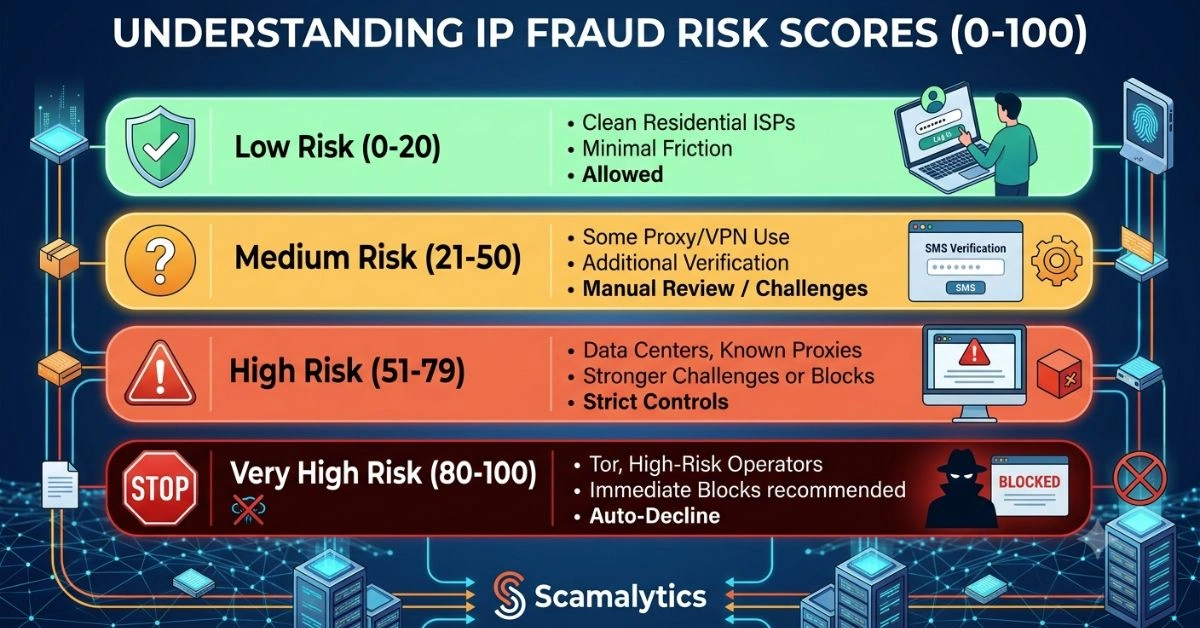
Risk Score Breakdown Table
| Fraud Score Range | Risk Level | Typical Characteristics | Common Use Cases for Blocking/Review |
| 0-20 | Low | Clean residential ISPs, low abuse history | Minimal friction for users |
| 21-50 | Medium | Some proxy/VPN use, mixed signals | Additional verification steps |
| 51-79 | High | Known proxy services, data centers, elevated abuse | Stronger challenges or blocks |
| 80-100 | Very High | Heavy fraud association, Tor, high-risk operators | Immediate blocks recommended |
This table is illustrative based on public examples from their site. Actual thresholds depend on your business risk tolerance.
Technical Deep Dive: IP Lookup, API, and On-Premises Options
Scamalytics offers multiple deployment methods to fit different needs.
Free Web Lookup: Quick checks for investigators or small teams. Useful for manual reviews.
API Integration: Real-time lookups with generous free tier (5,000 requests/month). Paid plans start at $25/month for 25,000 lookups, scaling efficiently for high-volume users. Responses include JSON with risk score, geolocation, proxy flags, etc. Bulk lookup tools are also available.
MMDB (MaxMind Database Format): On-premises solution for unlimited lookups at microsecond speeds. Ideal for enterprises with data residency requirements or high throughput needs. Updates are simple file replacements—no data leaves your environment.
Integration examples appear in platforms like OutSystems and ThreatQ, showing it plugs into existing fraud stacks without major overhauls.
Performance matters here. In fraud prevention, milliseconds count. Slow APIs can frustrate legitimate users or create bottlenecks. Scamalytics emphasizes low latency, especially with MMDB.
Scamalytics vs. Other IP Fraud Detection Tools
No single tool solves everything. Here’s a comparison based on available data:
| Tool | Starting Price | Key Strengths | Weaknesses | Best For |
| Scamalytics | Free tier; $25/mo | Focused IP scoring, MMDB option, dating/fraud expertise | Less broad feature set | IP-centric fraud teams |
| IPQualityScore | ~$99/mo | Comprehensive (email, domain, etc.) | Higher cost | Full-spectrum fraud |
| IP2Location | $99/year | Geolocation focus | Limited fraud signals | Marketing + basic checks |
| AbuseIPDB | Varies | Community abuse reports | Less predictive scoring | Threat intel |
| MaxMind | Varies | Widely used geo + fraud | Can be noisier | Established enterprises |
Scamalytics shines in simplicity and specialization. It’s not trying to be an all-in-one fraud platform but an enrichment layer that improves existing systems.
Real-World Applications: From Dating Sites to Banking
In online dating, Scamalytics’ user-level shared blacklists and ML models help catch scammers who create multiple profiles or reuse tactics. Romance fraud costs victims billions annually, and platforms face pressure to act faster.
For payments and banking, IP risk scoring adds a velocity check: sudden logins from high-risk IPs in distant locations can trigger reviews before money moves. Combined with other signals, it reduces chargebacks and account takeovers.
Classifieds and review sites use it to combat fake listings or review manipulation from proxy farms.
One strength is its focus on web traffic behavior. Fraudsters often test sites with automated tools or low-quality proxies—patterns Scamalytics observes across clients.
Challenges and Limitations of IP-Based Fraud Detection
IP scoring isn’t perfect. Dynamic residential proxies, compromised devices, and VPNs used by privacy-conscious legitimate users can create false positives. Scamalytics acknowledges this by providing context rather than binary verdicts.
Businesses must tune thresholds. A blanket block on score >50 might hurt international users. Layering with device intelligence, email verification, and behavioral biometrics is key.
Privacy regulations like GDPR add complexity. On-premises MMDB helps here by keeping lookups internal.
Hidden bad actors in the digital world often operate like classic villains in stories—adapting tactics, using disguises (proxies), and striking where least expected. Tools like Scamalytics act as modern sentinels, exposing patterns that reveal these threats.
Implementing Scamalytics: Best Practices for Maximum Value
- Start Small: Use the free tier and web lookup to test high-traffic pages or suspicious sign-ups.
- Layer Signals: Don’t rely on IP score alone. Combine with your existing stack.
- Monitor False Positives: Review blocked or challenged users regularly.
- Tune for Your Audience: E-commerce in high-fraud regions may need stricter settings than a local service site.
- Use MMDB for Scale: If volume grows or compliance demands it, switch to on-prem.
For technical scoring mechanisms, think of it like point-based evaluation systems in other domains—each data point contributes to an overall assessment, similar to how specialized guides break down complex point systems for precise decision-making.
The Future of IP Intelligence and Fraud Prevention
As AI-generated content, deepfakes, and sophisticated bots evolve, IP risk data will remain foundational. Scamalytics continues updating its models based on fresh observations.
Emerging trends include better residential proxy detection, integration with zero-trust architectures, and privacy-preserving techniques.
Businesses ignoring IP-level signals do so at their peril. Fraud losses compound quickly, and recovery is hard.
FAQs About Scamalytics
1. What exactly is a Scamalytics fraud score?
It’s a 0-100 rating indicating the likelihood an IP address is associated with fraudulent web activity, based on their observed network data.
2. Is Scamalytics free to use?
Yes for basic lookups and a 5,000 requests/month API tier. Higher volumes are paid.
3. How accurate is Scamalytics compared to competitors?
It performs strongly in independent tests for spammer detection, though accuracy varies by use case. Real-world results depend on integration and layering.
4. Can Scamalytics help with romance scams?
Absolutely—its origins and ongoing focus make it particularly effective there, with both IP and user-level tools.
5. Does using Scamalytics violate user privacy?
It processes connection data per their privacy policy. On-premises options minimize data sharing. Always review compliance for your jurisdiction.
6. What if my legitimate IP gets a high score?
Contact the site owner using the service, or use a different connection. Scores can change over time as behavior updates.
7. Is there a mobile app or bulk checker?
Web-based bulk tools exist; API suits automation. No dedicated mobile app mentioned.
Final Thoughts: Is Scamalytics Worth It?
For teams dealing with account fraud, payment risks, or user-generated content moderation, Scamalytics offers a reliable, no-nonsense signal that punches above its weight. It’s not magic—it won’t stop every sophisticated attack—but it raises the cost and effort for fraudsters significantly when used wisely.
In the ongoing cat-and-mouse game of cybersecurity, having clear visibility into connection risks is non-negotiable. Scamalytics provides that visibility with expertise forged in one of the toughest fraud environments: online romance.
Whether you’re a solo operator checking suspicious leads or part of a large trust and safety team, their tools deserve a spot in your toolkit. Test the free lookup today and see what patterns emerge in your own traffic. The data might surprise you—and save you headaches down the line.
For More Information Visit Aitrender.