



The Smartphone Peak and the Quiet Shift Happening Now
Smartphones reshaped daily life for nearly two decades. They sit in pockets, deliver instant access, and handle tasks once reserved for full computers. Yet the format shows its age. Users complain about battery anxiety, neck strain from constant downward glances, and the mental tax of juggling dozens of apps and notifications.
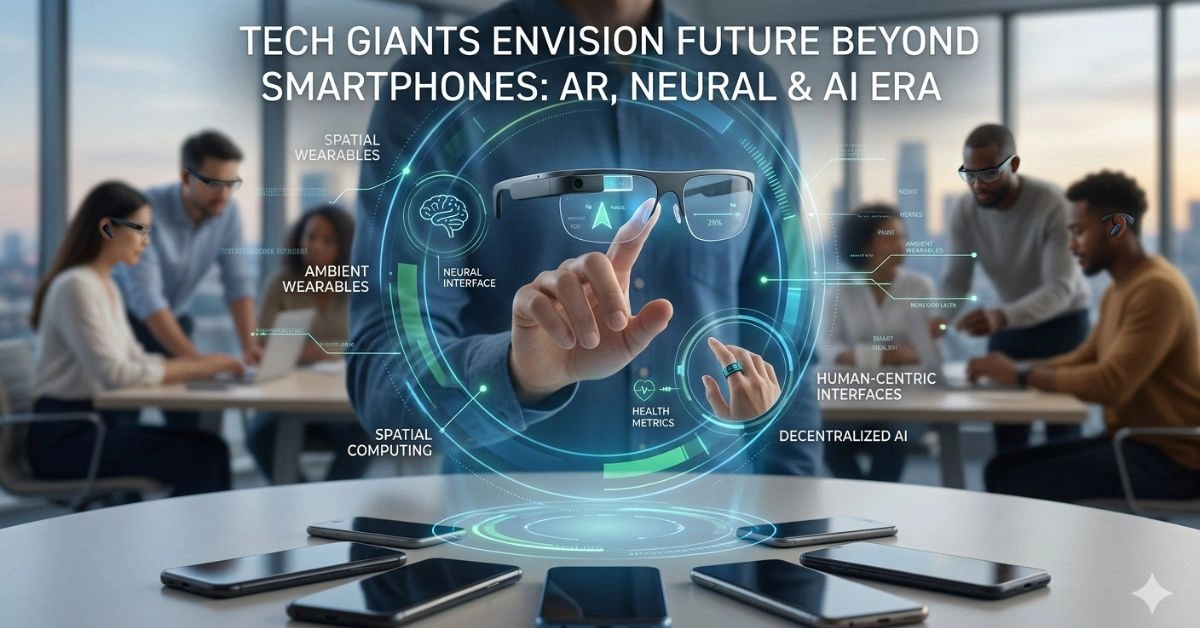
Major tech companies clearly see the limits. Apple, Meta, Google, and smaller players pour resources into devices that move computing away from rectangular screens and into more natural forms. This marks the early stage of a post-smartphone world where technology fades into the background instead of demanding attention.
When people search for how tech giants envision a future beyond smartphones, they want straight talk on timelines, working prototypes, and realistic barriers. The shift won’t happen in one jump. Smartphones will stick around as hubs for years, but their central role is already eroding.
Meta ships Ray-Ban smart glasses that handle calls, music, and live streaming while looking like normal eyewear. Apple sells Vision Pro as a high-end spatial computer and prepares lighter AR models. Google partners on AI glasses. Neuralink implants let users control computers with thoughts. These pieces point to interfaces that understand context without forcing users to stare at glass.
Why Pocket Screens No Longer Cut It
Physical constraints drive much of the change. Modern chipsets deliver strong performance, but squeezing them into thin bodies creates heat that throttles power and drains batteries faster. Users want always-available AI without plugging in every few hours. Lithium-ion chemistry improves slowly, and energy density gains have slowed.
Cognitive load adds another pressure. Research shows frequent phone checks fragment attention and raise stress levels. People sit in meetings or walk with friends while half-present on their screens. The always-on expectation creates burnout.
AI itself needs better inputs. Large language models handle complex requests well, but speaking to a phone in public feels awkward and voice assistants on current devices miss nuance. Ambient systems require always-listening, glance-based, or thought-based interaction with strong on-device processing for speed and privacy.
Market dynamics push companies forward too. Smartphone sales plateau in many regions. Tech giants hunt the next platform that keeps users inside their ecosystems for hardware, services, and advertising. Health monitoring for aging populations and accessibility needs for disabled users create additional demand for less intrusive devices.
The Main Contenders Shaping Tomorrow
Augmented Reality Glasses and Spatial Computing
AR glasses sit at the front of most roadmaps. They overlay information directly onto the real world while keeping users present.
Meta’s Orion prototype stands out as one of the most advanced. It uses holographic displays in a form factor close to regular glasses, with built-in AI for contextual help. The consumer Ray-Ban Meta edition already moves millions of units by adding cameras, speakers, and AI without looking tech-heavy.
Apple’s Vision Pro demonstrated spatial computing potential. Its eye-tracking, hand gestures, and room-scale understanding create immersive workspaces and entertainment. The current version feels heavy for all-day use, so Apple reportedly focuses next on lighter AR glasses targeting 2026-2027 release. These would use advanced micro-OLED or waveguide displays for better clarity across lighting conditions.
Google works with Samsung on Android-based AR glasses expected around 2026. Snap continues pushing Spectacles for creative and social use cases. The common technical hurdle involves balancing field of view, brightness, weight, and battery life. Many designs rely on neckband batteries or efficient edge chips to manage power.
Generative AI Hardware and Ambient Wearables
Not every task needs visual overlays. Screenless devices gain ground for quick, low-friction interactions.
Humane’s AI Pin showed early ambition but faced criticism for slow performance and limited battery. Newer attempts learn from those lessons. Smart rings from Oura, RingConn, and AI-focused startups like Vocci offer always-worn convenience. They track health metrics, record voice notes, translate conversations, and respond to subtle gestures.
Audio-first devices evolve rapidly too. Advanced earbuds with on-device AI handle translation, transcription, and personal assistants without pulling out a phone. These wearables excel at background tasks — monitoring vital signs, giving navigation cues through bone conduction, or summarizing meetings automatically.
The strength lies in minimal disruption. A ring stays on 24/7 with high compliance rates compared to watches. Combined with AR glasses, these create hybrid systems where the right interface handles the right moment.
Brain-Computer Interfaces and Direct Neural Links
The most radical direction removes external hardware entirely.
Neuralink’s N1 implant uses flexible threads with thousands of electrodes to read and stimulate brain activity. Early human trials let paralyzed patients move cursors, play games, and control devices through thought alone. The company also works on Blindsight to restore vision. By mid-2026, trial data showed improving signal quality and safety.
Synchron takes a different path with its stentrode, inserted via blood vessels without open brain surgery. This less invasive method already connects patients to external devices and draws partnerships with major tech firms for broader integration.
These systems start in medical applications but hint at consumer possibilities: thought-to-text for fast communication, direct control of smart environments, or enhanced memory and focus tools. Safety, long-term biocompatibility, and ethical questions around data ownership remain central concerns.
For professionals exploring tools that power these emerging interfaces, check our detailed coverage of AI automation trends at Aitrender.net.
Comparison of Next-Generation Hardware Paradigms
| Technology | Key Players | Expected Timeline | Core Strengths | Primary Barriers | Privacy Risks |
| AR Glasses / Spatial | Meta, Apple, Google, Samsung | Mainstream 2030+ (Early tech 2026) | Hands-free visuals, contextual navigation, immersive collaboration. | Weight, battery life limits, high component costs. | Always-on public space recording. |
| Ambient AI Wearables | Oura, Humane, various startups | Mature market: 2027–2029 | Ultra-discreet, 24/7 wear compliance, low cognitive strain. | No rich visual output, voice accuracy issues in noise. | Ambient voice capture without indicators. |
| Direct Brain Links (BCI) | Neuralink, Synchron, Blackrock | Consumer market: Post-2035 | Zero-latency intent capture, complete accessibility paths. | Surgical risks, long-term durability, regulatory approvals. | Thought about data protection and security. |
Technical Hurdles Slowing Mass Adoption
Optics engineering remains complex. Creating clear, wide-field holographic displays that work indoors and outdoors requires new materials and precise waveguide designs. Heat buildup in compact frames can cause discomfort after extended wear.
Battery technology advances incrementally. Solid-state cells promise better density and safety, but scaling production cheaply takes time. Edge AI helps by running smaller models locally, but sophisticated multimodal systems still push power limits. Techniques like dynamic model pruning and specialized neural processing units (NPUs) become essential.
Data privacy grows more critical with always-on sensors. Cameras in glasses, continuous audio capture, and especially neural signals demand new consent frameworks and strong encryption. Localized processing reduces cloud transmission but increases the value of each device as a potential attack target.
Regulatory and manufacturing challenges add friction. Medical-grade approvals for BCIs take years. Supply chains for micro-displays and biocompatible materials need massive scaling. Cost must drop dramatically for mainstream appeal — current high-end AR costs thousands, far above smartphone prices.
How Daily Life and Human Interaction Will Transform
When screens recede, eye contact during conversations could return as default. AR could show real-time translation subtitles, navigation arrows on the ground, or gentle reminders floating in peripheral vision without forcing users to look down.
Work environments change through spatial computing. Teams collaborate on shared 3D models visible to everyone wearing compatible glasses. Designers manipulate virtual prototypes with hand gestures. Writers capture ideas through thought or quick voice notes processed instantly.
Creativity and accessibility both benefit. Artists generate and refine concepts through natural gestures or neural links. People with mobility limitations gain new independence through thought-controlled environments.
Risks deserve equal attention. Over-reliance on AI suggestions might weaken certain cognitive skills. Immersive experiences could create new forms of addiction or social isolation. Digital divides may widen between those who adopt early and those who cannot afford or trust the technology.
Public policy must address recording consent in shared spaces and protect neural data with the same seriousness as genetic information. For businesses preparing for these shifts, our spatial computing guides offer practical implementation strategies.
The Road Ahead
Tech giants envision a future beyond smartphones as a gradual layering of new capabilities rather than sudden replacement. AR glasses offer the clearest near-term path for most users. Ambient wearables deliver immediate value today. Neural interfaces promise the deepest integration but face the longest timelines.
Success depends on solving human problems first — comfort, trust, genuine utility — rather than showcasing technical fireworks. Companies that balance bold vision with careful execution will shape the next decade of personal computing.
Smartphones will evolve into supporting roles, likely serving as powerful edge processors or backup interfaces. The real prize lies in creating technology that respects attention and enhances real-world presence.
FAQS
Lightweight AR models from Apple and Meta could see meaningful adoption between 2026 and 2028, but full replacement for most users likely waits until the early 2030s when battery life, comfort, and app ecosystems mature.
Neuralink uses ultra-thin flexible threads with high electrode density for better signal resolution. Its surgical robot aims for precision and scalability, though it remains more invasive than stent-based approaches like Synchron.
Some, like advanced smart rings and audio devices, already deliver solid value for health tracking and quick tasks. Full context-aware assistants still need better accuracy and integration before replacing phone functions entirely.
Always-on cameras, continuous audio capture, and especially neural data create serious concerns. Strong on-device processing helps, but clear user controls and regulatory standards will prove essential.
No. They will likely transform into different form factors or become backend infrastructure supporting new wearable ecosystems for the foreseeable future.
Meta leads in consumer-facing AR experimentation and volume shipping. Apple excels at polished ecosystem integration. Neuralink pushes the BCI frontier. No single winner has emerged yet.
Edge AI enables faster responses, better privacy, and offline functionality by processing data locally. It reduces latency for real-time AR overlays and neural decoding while limiting sensitive data transmission.