



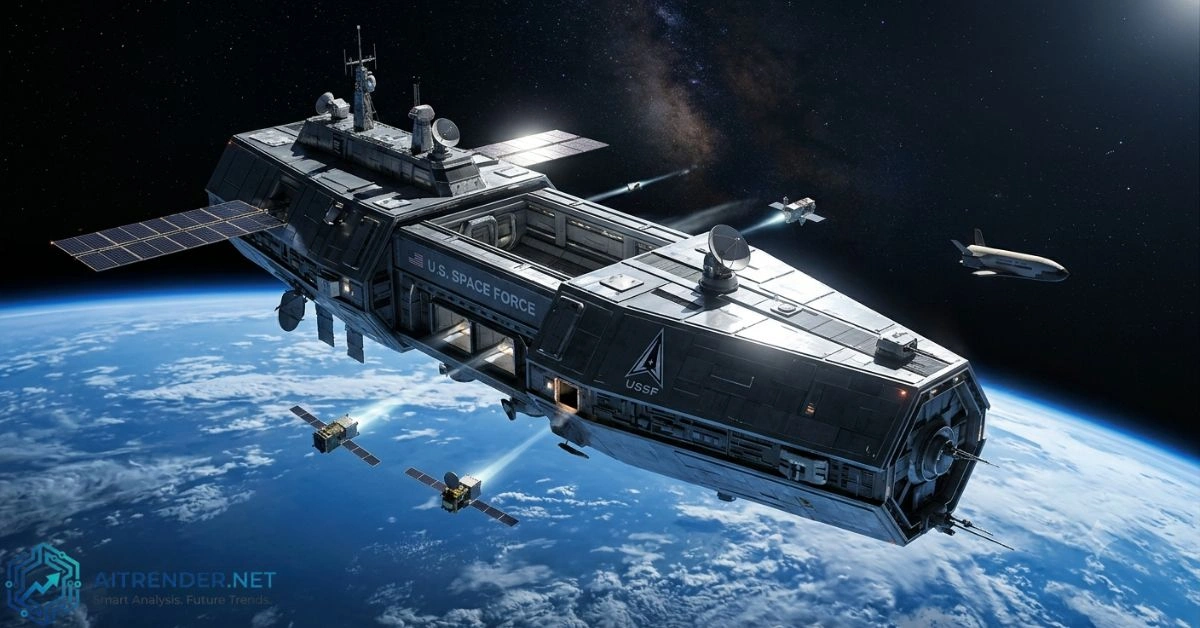
The idea of a massive platform cruising in orbit, deploying smaller craft on demand like jets from a naval carrier, sounds like science fiction. Yet the U.S. Space Force is actively funding development of exactly that: an orbital carrier system designed to change how the military operates in space.
This isn’t a crewed battleship bristling with lasers and railguns from movies. Current efforts focus on practical, near-term infrastructure for rapid satellite deployment and response in a domain where speed matters more than ever. China and Russia have tested anti-satellite weapons and maneuverable spacecraft, making traditional ground launches too slow for some scenarios. An orbital carrier could preposition assets and release them quickly when needed.
This article examines the concept’s roots, technical realities, strategic purpose, and broader implications based on publicly available information from the Space Force, industry partners, and space policy experts.
The Evolution of Military Space Assets
Military use of space began with reconnaissance satellites in the 1960s. Over decades, capabilities expanded to include GPS for precision navigation, missile warning systems, and secure communications that underpin nearly every modern operation.
The U.S. Space Force, established in 2019, marked a shift. Space moved from a support domain to a recognized warfighting environment. Guardians now organize, train, and equip forces to protect U.S. interests in orbit.
Key assets include the Boeing X-37B Orbital Test Vehicle. This reusable spaceplane has flown multiple long-duration missions, testing technologies, conducting experiments, and demonstrating maneuverability. It measures about 29 feet long with a 15-foot wingspan, weighs around 11,000 pounds at launch, and carries a small payload bay. Recent missions reached highly elliptical orbits and used aerobraking for efficient returns.
Ground-based systems like the Space Surveillance Network track tens of thousands of objects. Space-based sensors provide persistent awareness. Yet vulnerabilities remain. A single ground launch delay or adversary interference could leave gaps in coverage.
Concepts like orbital carriers address this by enabling “tactically responsive space” operations—pre-positioning hardware in orbit for on-demand use, bypassing weather, range conflicts, or launch queues.
What is a Space Force Orbital Warship Carrier?
The term “Orbital Warship Carrier” evokes grand imagery, but real development centers on platforms like Gravitics’ Orbital Carrier (sometimes called Diamondback in specific variants). Selected under a SpaceWERX STRATFI contract worth up to $60 million, it functions as a mothership in space.
It would store multiple smaller maneuverable vehicles or satellites in an unpressurized structure, then deploy them rapidly into chosen orbits. Think of it as a forward-deployed hangar rather than a Star Destroyer.
Key theoretical elements include:
- Propulsion and Maneuverability: Large platforms need efficient station-keeping and occasional orbit changes. Chemical propulsion or emerging electric systems could suffice for limited adjustments, though major moves remain fuel-intensive.
- Orbital Mechanics: Operating in low Earth orbit (LEO) or higher regimes involves balancing speed, altitude, and coverage. Carriers might loiter in strategic inclinations for rapid access to various theaters.
- Deployment Systems: Mechanisms to safely release and orient daughter craft without collision risks or excessive delta-v expenditure.
Gravitics targets flight demonstrations around 2027, starting with pathfinder missions to validate avionics, propulsion, and deployment.
This builds on existing tech like the X-37B’s reusability and docking experiments, plus commercial infrastructure work by companies like Axiom Space.
Technical Specifications & Strategic Role
Public details on full-scale “warship” versions remain limited, as much stays classified or conceptual. Here’s a comparison of the emerging Orbital Carrier concept against existing assets like the X-37B and the International Space Station (as a proxy for large orbital platforms):
| Asset | Approximate Size/Volume | Payload Capacity | Crewed? | Primary Role | Maneuverability | Status |
| X-37B OTV | 29 ft long, ~7×4 ft payload bay | ~500 lbs | No | Tech testing, experiments, SDA | High (aerobraking, orbit changes) | Operational, multiple flights |
| ISS (research platform) | ~350 ft across, ~32,000 cu ft pressurized | Varies, modular | Yes | Science, international cooperation | Limited station-keeping | Operational |
| Orbital Carrier (concept, e.g. Diamondback) | Large platform, ~2,100+ cu ft volume reported for variants | Up to 22,000+ lbs cargo capacity for hosted vehicles | No (unpressurized) | Pre-position & rapid deploy satellites/vehicles | Designed for on-demand release | In development, demos planned |
| Traditional Satellite | Small to bus-sized | N/A (itself is payload) | No | Specific missions (comm, ISR) | Limited | Operational |
The carrier’s strategic role centers on resilience and responsiveness. In a conflict, ground launches could face disruption. Pre-positioned assets allow quicker reconstitution of constellations for communications, targeting, or missile warning.
It supports space domain awareness (SDA) by hosting sensors or deploying inspectors. It could also enable defensive measures, such as releasing jammers or escorts for high-value satellites.
Geopolitical Implications of Space Weaponization
Nations increasingly view space as contested. Russia destroyed a satellite in 2021, creating debris that threatened the ISS. China has demonstrated similar capabilities. The U.S. responds by enhancing protection and responsiveness.
The 1967 Outer Space Treaty bans weapons of mass destruction in orbit and military bases on celestial bodies but permits conventional military activities and does not explicitly prohibit all weapons. This gray zone fuels development on all sides.
Critics worry about an arms race, while proponents argue deterrence prevents conflict by ensuring no one gains easy dominance. Comparisons to sci-fi tropes—like advanced tech villains in sprawling narratives—highlight how pop culture shapes public perception of these capabilities. For deeper dives into such imaginative parallels, see explorations of Superman villains and their technological threats.
Operational Logistics and Data Tracking
Command and control would rely on robust networks linking ground stations, other satellites, and the carrier itself. Real-time data fusion is critical.
Space Domain Awareness involves detecting, tracking, identifying, and characterizing objects while assessing intent. Systems monitor maneuvers, signals, and anomalies across vast distances.
Tactical metrics and monitoring draw parallels to strategic data systems in other domains. Effective operations require precise Drebin points-style tracking of assets, threats, and environmental factors to inform decisions.
Logistics challenges include resupply, power generation (solar arrays with batteries), thermal control, and collision avoidance in increasingly crowded orbits.
Challenges, Feasibility, and Future Outlook
Technical hurdles are significant. Launching massive structures costs billions. Orbital refueling and in-space assembly could help but demand mature infrastructure. Radiation, micrometeoroids, and debris pose constant risks. Propulsion for heavy platforms remains inefficient with current tech.
Feasibility improves through commercial partnerships. Gravitics’ work leverages private investment alongside government funding, accelerating timelines.
Looking ahead, successful demonstrations could lead to proliferated carriers or integrated architectures. Future versions might incorporate more advanced propulsion, AI for autonomous operations, or defensive systems within treaty bounds.
The U.S. isn’t alone. Allies and adversaries pursue similar concepts. International norms will evolve alongside technology.
Frequently Asked Questions (FAQs)
1. What is the Space Force Orbital Warship Carrier?
It refers to concepts like the Gravitics Orbital Carrier—a platform designed to store and rapidly deploy smaller spacecraft from orbit, enhancing tactical responsiveness.
2. Does the U.S. have a functional orbital warship?
No crewed or fully armed “warship” exists publicly. Development focuses on uncrewed carrier platforms for satellites and vehicles.
3. How does it compare to the X-37B?
The X-37B is a reusable test vehicle for experiments. The carrier would be larger, focused on hosting and deploying multiple assets rather than single-vehicle operations.
4. Is this a violation of space treaties?
Current concepts emphasize defensive and responsive capabilities. The Outer Space Treaty prohibits WMD but allows other military uses.
5. When could it become operational?
Pathfinder demonstrations are targeted for the late 2020s, with operational systems potentially following based on test results.
6. What threats does it address?
Anti-satellite weapons, jamming, and the need for rapid satellite replenishment in contested environments.
7. How does it impact everyday life?
By protecting GPS, communications, and weather satellites that millions rely on daily.
Conclusion
The Space Force Orbital Warship Carrier represents a pragmatic step toward treating space as a domain that requires persistent presence and quick reaction. Grounded in real engineering efforts rather than fantasy, it highlights the shift from vulnerable, Earth-dependent assets to more resilient orbital architectures. Success depends on balancing innovation, cost, and international stability—priorities that will define space power for decades.