



Introduction: Why the Air India Delhi to San Francisco Route Matters
Air India Flight AI 173 connects Delhi’s Indira Gandhi International Airport (DEL) to San Francisco International Airport (SFO) on one of the world’s longest non-stop commercial routes. This flight covers roughly 12,400 kilometers (about 7,700 miles) and typically takes 15 to 16 hours, depending on winds and routing. For travelers, it’s more than just a trip—it’s a direct lifeline between India and the Bay Area, carrying families, professionals, and tourists across continents without layovers.
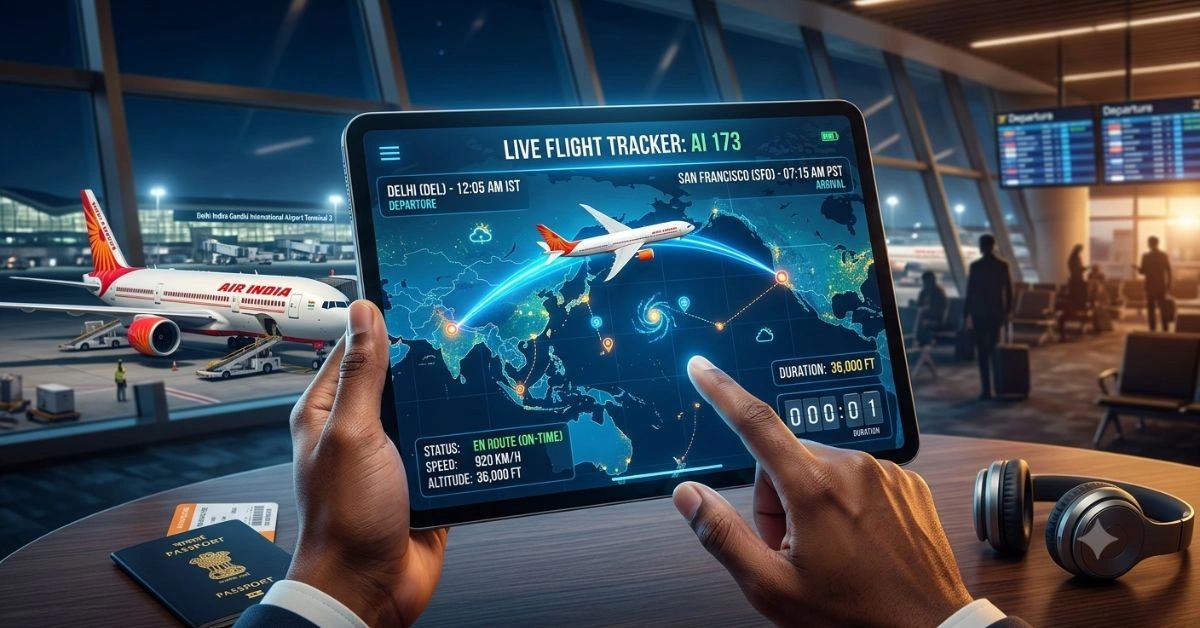
The “AI 173 Flight Status Live Map” has become essential for anyone involved with this flight. Whether you’re on board, picking someone up, or monitoring a loved one’s journey, these interactive tools provide real-time visibility that goes far beyond departure boards. They show the aircraft’s exact position, altitude, speed, and estimated arrival, updated frequently through global networks. This guide walks you through everything: how to track it effectively, what affects its performance, what to expect in the air, and practical tips drawn from real operations.
Passengers and their families rely on these maps because long-haul flights like this cross multiple time zones, oceans, and airspace regions where conditions change quickly. A quick glance at a live map can ease anxiety during a 15-hour journey that spans night and day.
Deep Dive into AI 173 Route, Schedule, and Vital Statistics
Flight AI 173 usually departs from Delhi Terminal 3 around midnight to early morning IST (schedules fluctuate slightly by day and season, often around 12:05 AM to 04:30 AM IST) and arrives at SFO in the morning Pacific Time, typically between 6:00 AM and 7:45 AM. The return flight, AI 174, operates on a similar long-haul pattern.
The route often takes advantage of jet streams for efficiency. Historically, Air India has used both polar routes (over the Arctic) and Pacific paths, with the latter sometimes offering better tailwinds and shorter effective times despite greater distance. Pilots and dispatchers choose paths based on weather, winds, and airspace availability—avoiding restricted zones where possible.
Here’s a comprehensive summary of the flight’s key statistics:
| Statistic | Details |
| Route | Delhi (DEL) to San Francisco (SFO) |
| Departure Airport | Indira Gandhi International, Terminal 3 |
| Arrival Airport | San Francisco International, International Terminal (Dianne Feinstein Terminal A) |
| Average Flight Duration | 15 hours 30 minutes to 16 hours |
| Distance | Approximately 12,385–12,404 km (7,700 miles) |
| Aircraft Type | Boeing 777-300ER (B77W) |
| Frequency | Multiple times weekly (subject to seasonal adjustments) |
| Typical Speed | Around 850–900 km/h at cruise |
| Time Difference | IST to PST (UTC+5:30 to UTC-7/8) |
This table captures the essentials at a glance. Actual times can vary due to operational factors, so always check current status.
The polar or oceanic routing adds complexity. Flights may arc north over Russia, Alaska, or across the Pacific, adapting to high-altitude winds that can shave or add an hour. These paths require special crew training and equipment for remote areas with limited traditional radar.
How Live Flight Tracking Maps Work
Live flight maps for AI 173 pull data primarily from ADS-B (Automatic Dependent Surveillance-Broadcast) technology. Modern aircraft like the Boeing 777-300ER carry transponders that broadcast GPS-derived position, altitude, speed, heading, and flight ID every few seconds. Ground receivers worldwide pick up these signals and feed them to platforms like Flightradar24 and FlightAware.
In remote ocean or polar regions, coverage comes from satellite-based systems (like Aireon) that extend tracking far beyond ground stations. This means even in the mid-Pacific, you can often see the plane’s progress accurately.
These maps aren’t just pretty graphics—they aggregate multiple data sources: ADS-B, radar, MLAT (multilateration for non-ADS-B planes), and airline reports. Updates happen every few seconds to a minute, showing the aircraft icon moving along its path with details like ground speed, vertical rate, and estimated time of arrival.
For families tracking AI 173, this visibility is reassuring. You can share a flight link, watch progress together, and get notifications for departure, landing, or delays. Tools also replay historical tracks, useful for understanding typical paths or past incidents.
Popular platforms include:
- Flightradar24: Detailed maps, weather overlays, and community features.
- FlightAware: Strong on alerts and historical data.
- Airline apps and sites for official status.
These systems have transformed travel from guesswork to precise monitoring.
Real-Time Status, Common Delay Factors, and Airport Logistics
Checking AI 173 status live is straightforward on the platforms mentioned. Look for current departure/arrival gates, taxi times, and any holds. Delays on this route aren’t uncommon due to its length and variables.
Key delay contributors:
- Weather and Jet Streams: Strong headwinds can extend flight time; thunderstorms at DEL or SFO cause ground holds.
- Airspace Congestion and Restrictions: Geopolitical factors limit certain paths, forcing detours.
- Technical or Operational Issues: Rare but possible, as seen in past diversions after several hours airborne.
- Airport Operations: DEL’s Terminal 3 handles heavy international traffic; SFO manages complex international arrivals.
At DEL Terminal 3, check in early for this long flight. Air India counters are well-signed. At SFO, arrivals are in the International Terminal. Baggage claim and ground transport are straightforward but busy—allow extra time.
Immigration and customs at SFO can take time for international arrivals, especially with many passengers from India. Have your documents ready.
In-Flight Experience and Technical Specifications of the Boeing 777-300ER
Air India’s Boeing 777-300ER is built for ultra-long-haul comfort. It features a three-class configuration with First, Business, and Economy cabins tailored for extended flights.
Seating and Amenities:
- Business Class: Lie-flat seats in 2-3-2 or similar, with generous pitch (around 76 inches), personal screens (15+ inches), power outlets, USB ports, and good recline. Amenity kits, quality meals, and attentive service help passengers rest.
- Economy: 3-3-3 layout with 31–33 inch pitch. Seats include IFE screens (10+ inches), power, and decent legroom for the class. Many report it’s manageable for the duration with preparation.
- General: The aircraft offers Wi-Fi (availability and speed vary), extensive entertainment libraries with Bollywood and international content, and multi-course meals suited to Indian and Western palates.
The 777-300ER’s twin engines provide reliability for long sectors. Cabin pressure and humidity systems are optimized to reduce fatigue. Noise levels are relatively low in modern 777s.
Travelers often recommend compression socks, neck pillows, hydration, and movement to combat the effects of a full day aloft.
Air India 173 Historical Performance and Best Tracking Tools
Over time, AI 173 has maintained solid on-time performance for its class, though long-haul international flights average 70-85% on-time depending on season. Historical data on FlightAware or Flightradar24 shows patterns: smoother Pacific crossings in certain months, occasional tech-related returns (handled with passenger safety first).
Best practices for tracking:
- Bookmark the flight on multiple apps.
- Set alerts for status changes.
- Cross-reference with Air India’s site or app for official gate and baggage info.
- For tech enthusiasts, explore how these tools integrate data—some even link to advanced concepts like data streaming in modern systems.
If you’re interested in the broader tech behind such tracking and related innovations, check out this guide on evolving data solutions: What is TransDS? 2026 Guide – Meaning & Uses. For deeper dives into specialized software ecosystems that power logistics and travel tech, see Wollwirrware Complete Guide 2026.
Conclusion and Final Travel Tips
Tracking AI 173 via live maps turns a distant, lengthy flight into something manageable and transparent. Preparation makes the difference: arrive early at DEL, stay hydrated, move during the flight, and use maps for peace of mind.
Pack smart, confirm baggage, download offline entertainment, and consider jet lag strategies—like adjusting sleep before departure. For SFO arrivals, arrange transport in advance, especially if tired after the journey.
This route showcases aviation’s reach, and tools like live maps keep everyone connected. Safe travels—whether you’re flying or watching from afar.
FAQS
1. What is the typical baggage allowance for AI 173?
For international long-haul on Air India, checked baggage is often 23–30 kg per piece in Economy (depending on fare brand), with higher allowances in Business/First. Carry-on is usually one bag up to 7–10 kg plus a personal item. Always verify via your booking or Air India’s calculator, as rules can vary.
2. How do I track AI 173 live if I’m picking someone up at SFO?
Use Flightradar24 or FlightAware with flight number AI173. Enable notifications. At the airport, check SFO displays or the Air India app for gate and baggage belt info.
3. What terminals are used for AI 173?
Departure: DEL Terminal 3. Arrival: SFO International Terminal A. Air India has a lounge at SFO for eligible passengers.
4. Are delays common on Delhi to San Francisco flights?
They occur due to weather, winds, or operations, but many flights run close to schedule. Monitor real-time and build buffer time for connections.
5. Is Wi-Fi available on AI 173, and how’s the connectivity?
Yes, but performance varies by location and provider. It’s useful for messaging but not always for heavy streaming.
6. What if the flight diverts or returns?
Safety protocols kick in. Air India arranges alternatives, hotels if needed, and communicates updates. Historical cases show efficient handling.
7. How accurate are live maps over the ocean?
Very good thanks to satellite ADS-B. Positions update reliably even in remote areas.
8. Any tips for sleeping on this long flight?
Choose a good seat if possible, use eye masks/earplugs, stay hydrated, and avoid heavy meals before sleep. Business Class offers better rest options.
9. Where can I find historical performance data for AI 173?
FlightAware and Flightradar24 have detailed histories, including past routes and timings.