



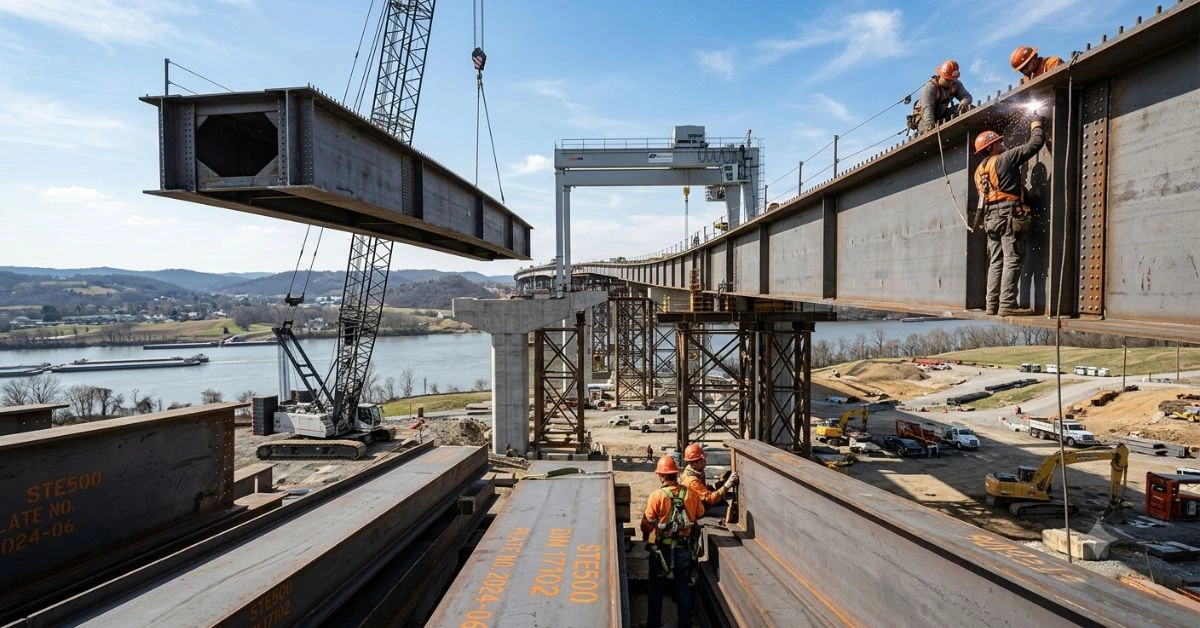
If you’re specifying materials for bridges, heavy machinery, or large-scale infrastructure, you’ve likely come across STE500. This German-standard high-strength low-alloy (HSLA) steel delivers serious performance without unnecessary weight or cost. Engineers and fabricators turn to it when standard carbon steel falls short on yield strength but ultra-premium grades feel overkill.
I’ve spent years working with structural steel on projects ranging from highway overpasses to mining equipment. STE500 consistently stands out for its balance of strength, weldability, and toughness. Here’s a practical, no-fluff breakdown based on real specs, testing data, and field experience.
What Exactly Is STE500 Steel?
STE500 (often written as StE500 or StE 500) comes from the DIN 17102 standard for weldable fine-grain structural steels. It’s normalized or supplied in a controlled-rolled condition to achieve a fine-grained microstructure that boosts both strength and impact resistance.
The “500” refers to its minimum yield strength of 500 MPa (about 72.5 ksi) for thinner plates. That puts it firmly in the high-strength category, offering roughly 40-50% more load-bearing capacity than common S355 or ASTM A572 Gr.50 steels in many applications.
Key advantages:
- Fine grain structure for better toughness at low temperatures
- Low carbon equivalent for excellent weldability
- Good formability despite the high strength
- Normalized delivery that reduces internal stresses
This isn’t exotic quenched-and-tempered steel. It’s a practical, reliable HSLA that fabricators actually enjoy working with.
Chemical Composition of StE500
The chemistry is tightly controlled to deliver strength through micro-alloying rather than high carbon content. Typical maximum values (based on DIN 17102 and supplier data):
- Carbon (C): 0.21%
- Silicon (Si): 0.10–0.60%
- Manganese (Mn): 1.00–1.70%
- Phosphorus (P): 0.035%
- Sulfur (S): 0.030%
- Nitrogen (N): 0.020%
- Aluminum (Al): min 0.020%
- Other elements like Nb, Ti, V in controlled combinations (total Nb+Ti+V max around 0.22%)
The low carbon and controlled alloys keep the carbon equivalent (CEV) low—usually under 0.45—which means you can weld it without extensive preheating in most cases. That’s a huge time and cost saver on site.
Mechanical Properties: What You Can Actually Count On
Here’s where STE500 shines. Properties vary slightly by thickness:
| Thickness (mm) | Yield Strength ReH min (MPa) | Tensile Strength Rm (MPa) | Elongation A min (%) | Bend Test (Mandrel) |
| ≤ 16 | $500 | 610 – 780 | 18 | 3a longitudinal / 4a transverse |
| 16 < t ≤ 35 | $480 | 610 – 780 | – | – |
| 35 < t ≤ 50 | 470 | 610 – 780 | – | – |
| 50 < t ≤ 60 | 460 | 610 – 780 | – | – |
Impact toughness is solid, especially in the normalized condition. Many suppliers guarantee Charpy V-notch values at -20°C or lower, making it suitable for outdoor and cold-climate structures.
Compared to mild steel (yield ~235-355 MPa), you get dramatically higher load capacity in the same section size. Or you can use thinner plates and cut weight—critical for mobile equipment or long-span bridges.
Real-World Applications of STE500 Steel
This grade isn’t sitting in a lab. It’s out there doing heavy lifting every day.
Bridge Construction: Highway bridges, railway viaducts, and pedestrian overpasses benefit from the high strength-to-weight ratio. Fabricators can use lighter girders while meeting strict deflection and fatigue requirements.
Heavy Machinery & Equipment: Crane booms, mining dump truck bodies, excavator arms, and offshore platform components. The toughness helps resist fatigue and impact loads.
Building Structures: High-rise columns, stadium roofs, and industrial halls where reducing steel tonnage lowers foundation costs.
Shipbuilding and Marine: Certain non-critical structural parts where corrosion protection is applied.
Renewable Energy: Wind turbine towers and foundations in some designs, though higher grades often take the top sections.
In one project I consulted on, switching to STE500 for bridge girders shaved nearly 15% off the steel weight while maintaining full safety factors. The savings in transportation and erection were noticeable.
STE500 vs Other High-Strength Steels: Practical Comparison
Choosing the right grade always involves trade-offs. Here’s how STE500 stacks up:
- Vs S355 (common European structural steel): STE500 offers ~40% higher yield strength. Use it when you need to reduce section sizes or increase spans.
- Vs S460 / S500 equivalents: Very similar performance. STE500 is often more readily available in certain European supply chains.
- Vs ASTM A572 Gr.65 or A709: Close match in strength. STE500’s fine-grain practice can give better toughness.
- Vs Quenched & Tempered (e.g., S690Q): Lower strength than S690 but easier to weld and often cheaper. Reserve QT grades for the most extreme loads.
- Vs S500MC (EN 10149): S500MC is thermomechanically rolled for better formability in cold forming. STE500 is a more general-purpose normalized plate.
Rule of thumb: If your design needs yield above 450 MPa, good weldability, and moderate forming, STE500 is often the sweet spot.
Welding, Fabrication, and Machining Tips
Weldability is one of STE500’s strongest points. Use matching strength fillers like E550 or equivalent. Low-hydrogen processes (MAG, TIG, or SMAW with proper electrodes) are recommended.
Preheating is usually minimal or none for thinner plates if CEV is controlled. Always follow EN 1011 guidelines or your procedure qualification records.
Forming: Cold forming is possible but respect the minimum bend radii. Hot forming (if needed) should stay below critical temperatures to preserve properties.
Machining: Higher strength means more tool wear than mild steel. Use robust tooling, proper speeds/feeds, and coolant. It machines cleanly once you dial it in.
Corrosion Protection: Like most structural steels, it needs painting, galvanizing, or other coatings for long-term exposure. It’s not stainless.
For smartphone-related hardware troubleshooting or managing device features during field inspections on job sites, quick references like how to turn off phone flashlight can save battery when documenting welds or inspections late into the night.
Sourcing STE500: What to Look For
Reputable mills (ThyssenKrupp, Dillinger, or quality Chinese/European producers with full traceability) provide 3.1 certificates. Demand:
- Heat analysis and product analysis
- Mechanical test results per plate or batch
- Ultrasonic testing for internal defects on thicker plates
- Impact test results at specified temperature
Thickness range is typically 6–100 mm or more, depending on supplier. Plates come in standard widths (1500–3000 mm) and lengths up to 12–18 meters.
Current market pricing fluctuates with raw materials, but expect a premium over S355. The weight savings often justify it.
Heat Treatment and Processing Considerations
STE500 is usually supplied normalized (+N). Additional normalizing or stress relieving is possible but rarely needed if properly fabricated. Avoid excessive heating that could coarsen the grain and reduce toughness.
For specialized architectural or niche applications involving German engineering terms or elements like Dachhut (roof structures in traditional or modern builds), STE500’s strength supports innovative lightweight designs.
Environmental and Sustainability Angle
High-strength steels like STE500 contribute to sustainability by reducing material use. Less steel means lower embodied carbon in the structure, easier transport, and reduced foundation sizes. Many modern projects specify such grades precisely for LEED or BREEAM credits.
Recyclability is excellent—steel is the most recycled material on the planet.
Common Challenges and How to Overcome Them
- Availability: Not every local stockist carries it. Plan ahead or work with specialist distributors.
- Cost perception: Higher upfront price per ton, but lower total project cost due to reduced tonnage.
- Design codes: Ensure your engineer is familiar with the standard (DIN, Eurocode 3). Conversion to local codes is straightforward.
- Fatigue: Like all steels, detail design matters more than the material itself for cyclic loading.
Future Outlook for High-Strength Steels Like STE500
The push for lighter, greener structures keeps demand strong. While newer grades (S700 and beyond) emerge, STE500 remains a workhorse because it’s proven, widely understood, and cost-effective for the majority of high-load applications.
Expect continued improvements in cleanliness and consistency from modern mills.
FAQS About STE500 Steel
1. What does STE500 stand for?
It’s the designation under DIN 17102 for a weldable fine-grain structural steel with minimum 500 MPa yield strength.
2. Is STE500 the same as S500?
Close but not identical. STE500 follows the older DIN standard; S500 refers to newer EN grades. Properties overlap significantly.
3. Can STE500 be welded easily?
Yes. Its low carbon equivalent makes it one of the more welder-friendly high-strength steels. Follow standard procedures.
4. What are typical applications?
Bridges, cranes, heavy equipment, buildings, and structural components requiring high strength and good toughness.
5. What thickness is available?
Commonly 6 mm up to 100+ mm. Check with suppliers for specific project needs.
6. How does it compare in price to S355?
Usually 20-40% more per ton, depending on market conditions, but total steel weight can drop enough to offset this.
7. Does STE500 require special corrosion protection?
It behaves like other carbon steels—paint systems, galvanizing, or cathodic protection are standard depending on the environment.
8. Are there ASTM equivalents?
Rough equivalents include ASTM A572 Grade 65 or A709 Grade 50W/70W with adjustments for chemistry and testing.
9. Can it be used in cold climates?
Yes, especially with guaranteed impact properties at sub-zero temperatures.
10. Where can I buy certified STE500 plates?
Major steel service centers, mills with export capability, or through engineering procurement specialists. Always demand full mill certificates.
STE500 won’t win headlines like ultra-high-strength exotic alloys, but it quietly solves real engineering problems every single day. When your project demands more strength without complexity, this grade delivers.